 Monmore dogs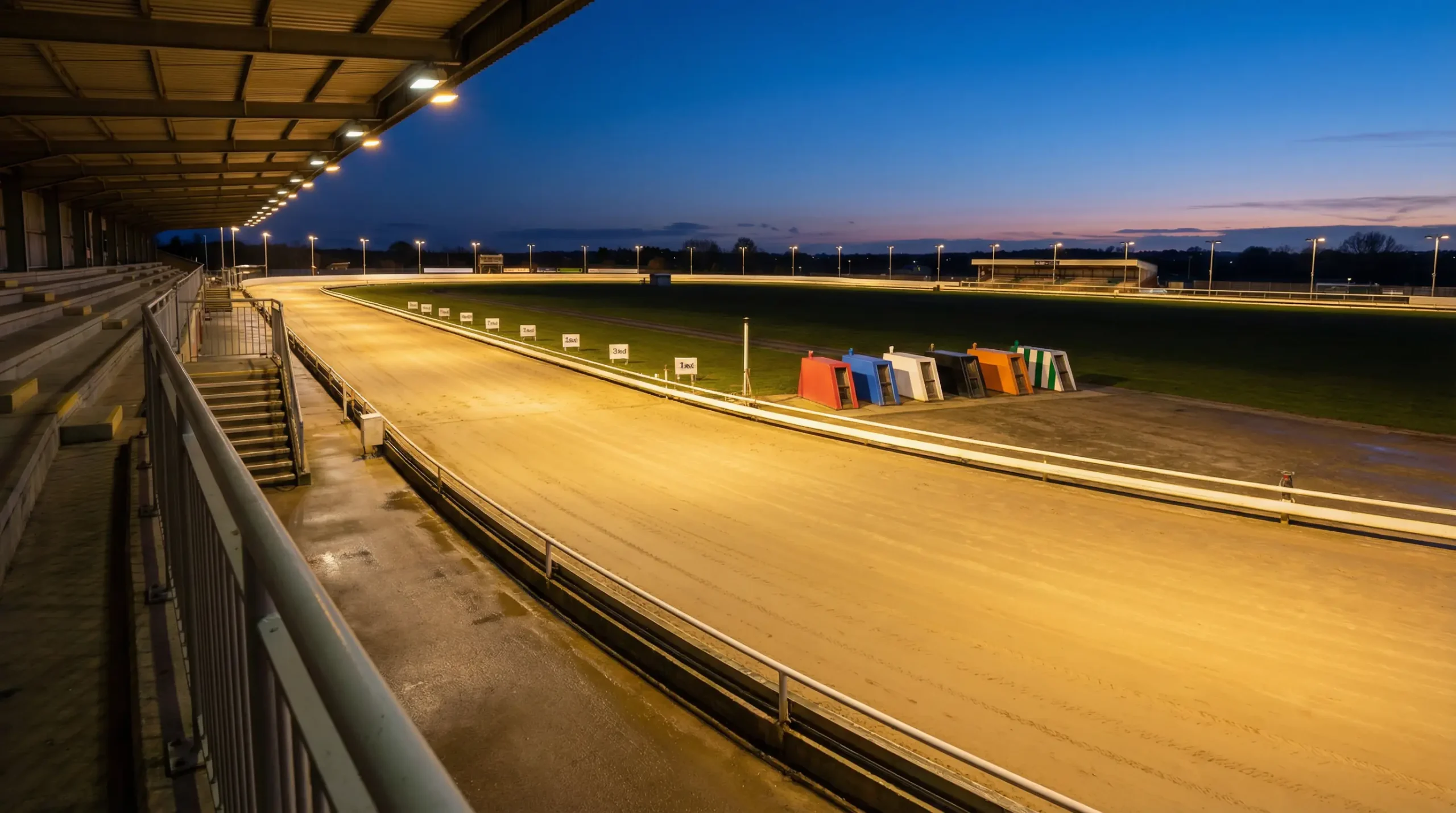
Best Greyhound Betting Sites – Bet on Greyhounds in 2026
Loading...
Monmore Green: Track Profile and Layout
419 metres of sand, six traps, and a Swaffham hare. Monmore Green sits a mile south-east of Wolverhampton city centre, on Sutherland Avenue, between the railway line and East Park. It is one of around eighteen GBGB-licensed tracks operating in the United Kingdom in 2026, owned and operated by Entain Group, and among the busiest in terms of fixture volume. Matinee meetings run on Monday, Tuesday, Wednesday and Friday afternoons under the BAGS (Bookmakers’ Afternoon Greyhound Service) banner. Evening meetings — the higher-profile cards — take place on Thursday and Saturday, with first races typically going off shortly after six o’clock.
The track itself is a flat, left-handed oval with four bends and a circumference of 419 metres. The racing surface is sand — not the silica sand used on some synthetic horse racing tracks, but a granular sand compound designed specifically for greyhound racing. The hare system is an outside Swaffham, which runs on a rail outside the main racing line. Dogs chase it anticlockwise, and the hare operator controls its speed from a booth overlooking the track, adjusting pace to keep it visible but uncatchable.
The stadium itself is built on three levels. The ground floor provides trackside access. The upper levels house a glass-fronted restaurant, private suites, and bars on each floor. The licensed capacity is 1,150 for greyhound meetings. Parking is free, and the stadium sits close to the Priestfield Metro stop, making it accessible from central Wolverhampton without a car. For a track approaching its centenary, the infrastructure is functional and well-maintained — not glamorous, but purposeful, which is about right for a venue that hosts racing six days a week.
What distinguishes Monmore from other GBGB tracks is not the facilities but the racing geometry. The 103-metre run from the traps to the first bend, the sand surface, and the range of distances — from 264-metre sprints to 900-metre marathons — produce a racing character that is specific to this venue. Understanding that character is the difference between treating Monmore as a generic greyhound track and reading it as the particular course it is. This guide covers the physical track in detail: its distances, its surface, its trap draw tendencies, and the conditions that alter them.
Race Distances: 264m to 900m Breakdown
Six distances, six different races. Monmore Green stages greyhound racing over 264, 480, 630, 684, 835, and 900 metres. Each distance uses a different starting position on the track and involves a different number of bends, which means each produces a different style of race. A 264-metre sprint is over in less than sixteen seconds and rewards raw acceleration. An 835-metre staying event takes close to a minute and demands sustained pace, tactical positioning, and stamina that many sprinters simply do not possess.
The 480-metre trip is by far the most commonly raced distance. The majority of BAGS afternoon meetings and evening graded races are run over 480 metres, which makes it the distance with the deepest pool of form data and the most reliable basis for comparison between dogs. If you are starting to build an understanding of Monmore, 480 metres is where the learning curve is shortest because the sample size is largest.
The less common distances — 264, 630, 684, 835, and 900 metres — feature on specific race types. Sprints over 264 metres are typically found in graded races and certain competitions. The 630-metre trip is used for middle-distance events and some open races, including the Ladbrokes Festival 630s. The 684-metre and 835-metre distances are staying trips used in events like the Ladbrokes Summer Stayers and selected graded races. The 900-metre marathon is rare, reserved for specific competitions that test endurance at its extreme.
Each distance interacts differently with Monmore’s track geometry. Over 264 metres, there are only two bends, and the race is essentially decided by trap speed and the first turn. Over 835 metres, the dogs navigate multiple bends, and the ability to hold a racing line through sustained cornering becomes as important as raw pace. The data you need to assess a dog changes with the distance, and treating all Monmore races as if they were the same 480-metre trip is one of the more common analytical errors punters make.
264m Sprint: Two Bends, Pure Speed
The shortest trip at Monmore leaves no room for error or recovery. Two bends, roughly fifteen to sixteen seconds of running, and a finish line that arrives before most dogs have hit their full stride pattern. Sprint races are won by dogs that break fast, reach the first bend in front, and hold their line through two turns without losing momentum. A dog that is slow out of the traps in a 264-metre race is not coming back. The race is too short for closing speed to compensate for a poor start.
Trap draw is amplified over this distance. The inside traps — particularly one and two — carry a pronounced advantage because the run to the first bend is completed at speed, and the inside dog reaches the turn on the shortest line. Sprint results at Monmore show a higher concentration of inside-trap winners than any other distance, which makes the draw a primary factor rather than a secondary one. If you are analysing a 264-metre race, start with the trap and the dog’s break speed before you look at anything else.
480m Standard: The Benchmark Distance
Most races, most grades, most data. The 480-metre trip is the bread and butter of British greyhound racing, and at Monmore it accounts for the majority of races across both afternoon and evening meetings. Four bends, roughly twenty-nine to thirty seconds at competitive level, and enough distance for the race to develop a shape: a leader emerges at the first bend, the field organises through the second and third turns, and the final straight determines whether the front-runner holds or a closer arrives in time.
What makes 480 metres analytically useful is volume. Because most dogs race this distance more frequently than any other, the form data is deeper and more directly comparable between runners. A dog’s best 480-metre time at Monmore, adjusted for going, provides a meaningful performance benchmark. Sectional times to the first bend, recorded over 480-metre races, are the most reliable early-pace indicators available. If you are going to specialise in one distance at Monmore, this is the one where your homework generates the greatest return.
The grading system is most finely calibrated at 480 metres. Grades from A1 down to A11 are populated primarily by 480-metre runners, which means the competition within each grade is theoretically tighter and the form more predictive than at distances where the grading bands are broader. A dog stepping up or down a grade at 480 metres is moving between well-defined levels. The same move at 630 or 835 metres may involve a less uniform field.
630m, 684m and 835m: Middle to Marathon
Beyond 630 metres, the race changes character. The emphasis shifts from trap speed and first-bend positioning to stamina, sustained pace, and the ability to negotiate multiple bends without drifting wide or losing ground. Dogs that excel over these distances are typically different in build and temperament from out-and-out sprinters: leaner, lighter, and capable of maintaining their racing effort over a longer period.
The 630-metre trip is the most common of the staying distances and features in the Ladbrokes Festival 630s, one of Monmore’s flagship events. It adds two additional bends beyond the standard trip, which creates more opportunity for positional change through the race. A dog that is third at the second bend has more ground — and more bends — through which to improve its position than it would over 480 metres. Late closers and dogs with strong finishing pace find more value at 630 metres than they do over shorter trips.
The 684-metre and 835-metre distances are genuine staying tests. At 835 metres, a race takes close to fifty-five seconds, and the dog that leads at the first bend is not always the dog that leads at the last. Stamina becomes the primary differentiator, and form over shorter distances is a weaker predictor of performance. If a dog has been competitive over 480 metres but is stepping up to 835 for the first time, its sprint form tells you it has pace but nothing about whether it can sustain that pace for nearly twice the distance. Staying form should be read separately from sprint form, and the two should not be blended without caution.
The 103-Metre Run to the First Bend
That number — 103 — defines Monmore’s racing character. The distance from the starting traps to the first bend is 103 metres, and it is the single most important physical measurement on this track. It determines how much time dogs have to reach racing speed before they must negotiate the first turn. It determines whether inside-drawn runners can establish position before wide runners close across. It determines the value of early pace and the penalty for a slow break. Every Monmore-specific pattern — trap bias, sectional times, race shape — traces back to this measurement.
By UK greyhound standards, 103 metres is a moderate run-up. Some tracks offer shorter runs that compress the field into the first bend before any dog has fully accelerated, producing chaotic first turns and frequent crowding. Others have longer runs that give wide-drawn dogs time to cross the field and reach the inside rail before the bend. Monmore sits in between: long enough for genuine pace to assert itself, short enough for positional disadvantage to persist through the turn.
The practical consequence is that dogs with quick trap breaks and early acceleration hold a structural advantage at Monmore. A dog that consistently reaches the first bend in the leading two positions has already overcome the point in the race where interference is most likely and track position most valuable. From the first bend onward, the race becomes about maintaining speed and negotiating the remaining turns. But the first bend is the filter. It determines who races in clean air and who runs in traffic, and at Monmore, that determination is made in the opening six to seven seconds.
For punters, the 103-metre run makes first-bend sectional times the single most valuable predictive metric on the racecard. A dog’s time to the first bend captures its break speed, its early acceleration, and its ability to hold its running line under pressure from adjacent traps. All other things being equal, the dog that reaches the first turn fastest wins more often than any other statistical predictor at this track. Not always. But often enough that ignoring sectional data means ignoring Monmore’s most revealing number.
Sand Surface and Going Conditions
Sand is not dirt and it is not turf. The racing surface at Monmore Green is a specially maintained sand track, designed to provide consistent grip and cushioning for greyhounds running at speeds that can exceed sixty kilometres per hour. The sand is graded, watered, and harrowed between meetings to maintain evenness and to prevent the surface from developing ruts or uneven patches that could cause injury or distort race results.
The going — the condition of the track surface on a given day — is the variable that sits between the dog and the clock. On a dry surface that has been well prepared, the going is typically described as standard or fast, and race times reflect the dog’s ability with minimal external interference. When conditions change — through rain, temperature shifts, or inconsistent preparation — the going changes, and times shift with it. A dog that runs 29.60 over 480 metres on a fast surface might clock 29.90 or worse on a slow, rain-affected track. The dog is running the same race. The surface is not.
Going conditions at Monmore are less variable than at grass tracks but more variable than many punters assume. Sand tracks do respond to weather, and the nature of that response is specific to the sand type, the drainage, and the degree of maintenance. Monmore’s surface drains reasonably well, but sustained rain can compact the sand and produce a slower, heavier going that alters race dynamics. Wind, though less discussed, also plays a role: an exposed section of the track facing a headwind will slow dogs in that portion of the race, potentially favouring those that conserve energy on the sheltered bends.
The going allowance — a numerical adjustment applied to race times to account for surface speed — is published by data providers like Timeform for every Monmore meeting. This allowance converts raw times into adjusted figures that are comparable across different meetings and conditions. A positive going allowance means the track was running slow; a negative allowance means it was running fast. The adjusted time is the closest available approximation to what the dog would have run on a perfectly standard surface, and it is the figure you should use when comparing form across different meeting dates.
How Rain Changes the Monmore Track
The first twenty minutes of rain compact the surface. This is counterintuitive — you might expect rain to soften sand, making it slower — but light rain on a dry sand track initially binds the top layer, creating a firmer surface that can actually produce faster times. It is only when the rain continues, saturating the sand beyond its drainage capacity, that the surface becomes heavy and genuinely slow. The transition between fast-running damp sand and energy-sapping wet sand is not gradual. It tends to occur over a relatively narrow window, which means the going can change between races on the same card if rain arrives mid-meeting.
For punters, rain at Monmore creates both risk and opportunity. The risk is that pre-race assessments based on standard going become unreliable as conditions shift. The opportunity is that the market — the collective judgement of the betting public — often adjusts slowly to changing conditions. A dog with known form on heavy ground, running on a card where rain has turned the surface late in the meeting, may be underpriced because the market is still pricing the earlier, faster conditions. Conversely, a front-runner that excels on fast sand may be overbet if the ground has turned against its preferred conditions between the time the odds were set and the time the traps open.
Checking the weather forecast before a Monmore meeting is not superstition. It is part of the analysis. Sand-track conditions respond to rain in a pattern that is broadly predictable once you understand the threshold, and that understanding converts directly into better race-reading on nights when the weather refuses to cooperate.
Trap Draw Data: Which Boxes Win Most
Every track has a personality in the draw, and Monmore’s is shaped by the 103-metre run to the first bend and the left-handed configuration. Trap one — the innermost starting position — sits closest to the inside rail and has the shortest path to the first turn. Trap six sits widest. In a vacuum, every trap would produce an equal share of winners: roughly 16.7 percent each. At Monmore, the distribution is uneven, and the unevenness is consistent enough to qualify as a structural bias rather than random fluctuation.
Over large samples of 480-metre races, trap one at Monmore produces winners at a rate above the 16.7 percent baseline, while trap six produces winners below it. Traps two and three tend to run close to or slightly above the baseline, and traps four and five sit at or slightly below. The exact percentages shift between seasons and between meeting types — evening cards with higher-graded dogs produce slightly different patterns from BAGS afternoon meetings — but the direction of the bias is consistent. Inside traps win more often than outside traps, all else being equal.
The mechanism is geometric. The dog in trap one reaches the first bend on the shortest line, with no rival between it and the rail. If it breaks cleanly, it can take the bend on the inside without interference. The dog in trap six must either run a wider arc around the bend — covering more ground — or angle sharply towards the rail and risk crowding with dogs breaking from traps three, four, and five. Over 480 metres, the additional distance run wide through the first two bends adds up to roughly two to three body lengths, which at racing pace translates to several hundredths of a second. In a sport where races are decided by hundredths, that margin matters.
The bias does not make trap one a guaranteed winner or trap six a guaranteed loser. A fast dog in trap six will beat a slow dog in trap one every time, because class overrides geometry. What the bias tells you is that when two dogs of similar ability meet, the one drawn inside holds a measurable positional advantage that is not reflected in the racecard form figures. Form was achieved from a specific trap in a specific race. Tonight’s draw may be different, and the adjustment is yours to make.
The most practical use of trap draw data is as a tiebreaker. When your analysis of form, sectional times, and going produces two or three dogs that look closely matched, the draw provides a final filter. It will not turn a weak selection into a strong one, but it will help you choose between candidates that the rest of the racecard cannot separate.
Trap Bias by Distance at Monmore
The bias shifts when you move from sprints to stays. Over 264 metres — two bends, under sixteen seconds — the inside-trap advantage is at its most extreme. The race is so short that any positional disadvantage from a wide draw has no time to correct. A dog drawn in trap six over 264 metres needs to be meaningfully faster than the inside-drawn runners just to compete, because the geometry consumes its advantage before the race develops.
Over 480 metres, the bias remains present but softens. The four-bend race gives wide-drawn dogs more time and more opportunities to find a racing line, and the additional distance allows class and stamina to offset some of the positional deficit. A strong closer drawn in trap five or six can still win 480-metre races by running through the field from the third bend onward — something that is almost impossible over two bends.
Over staying distances — 630 metres and beyond — the trap bias diminishes further. More bends mean more positional reshuffling, and the longer race duration means that early speed, the factor most amplified by inside draws, is less decisive than sustained pace and race sense. At 835 metres, the trap draw is still a factor, but it is a smaller one than it is at 264 or 480. The practical implication is that trap data should be weighted differently depending on the distance you are analysing. Punters who apply 480-metre trap bias assumptions to staying races overweight the draw and underweight the stamina profile of each dog.
Facilities and Visitor Information
The stadium holds 1,150 and charges nothing for afternoon admission. Evening meetings — Thursday and Saturday — carry general admission of six pounds, with under-eighteens free. General admission covers the main areas of the track including the ground-floor bars and standing areas, but not the restaurant or private suites, which are booked separately.
Monmore’s three-level grandstand offers a bar on each floor, a trackside snack bar on the ground level, and a glass-fronted restaurant on the upper floor with tiered seating and table service. The restaurant offers a clear view of the track from an elevated position and serves food through the evening meeting. For a more casual experience, the ground floor and outdoor areas provide direct access to the track rail, where you can watch the dogs run at close range and feel the sand shift as the field comes through the home straight.
Getting to the stadium is straightforward. Monmore sits just off the A41 Bilston Road, roughly a mile from Wolverhampton city centre. Drivers from the M6 should exit at junction 10 and follow signs for Wolverhampton via the A454. The stadium car park is free and accommodates several hundred vehicles. By public transport, the Priestfield Metro stop is a short walk from the venue, and Wolverhampton railway station is the closest mainline option, about a mile away. Local buses on routes 53, 79 and the A5 stop within walking distance.
The stadium address is Monmore Greyhound Stadium, Sutherland Avenue, Wolverhampton, WV2 2JJ. Race times vary slightly by day: Thursday evening cards typically start first race around 6.14pm, Saturday evenings around 6.31pm. Afternoon BAGS meetings begin at approximately 2pm. Doors open half an hour before the first race on evening cards. A printed racecard is available on entry and included with admission. For those watching remotely, Monmore meetings are broadcast through SIS to licensed bookmakers and are available for live streaming on platforms carrying the SIS greyhound feed.
The Track You Can’t See from the Stands
Track data is what separates punters from spectators. From the stands, Monmore looks like a flat oval with six traps and a hare. You can see the dogs run, you can see who finishes first, and you can hear the roar — or the groan — when the result lands. What you cannot see from the stands is the track beneath the race: the surface condition that altered the times, the drainage gradient that affects bend speeds after rain, the 103-metre measurement that shapes every first turn, the trap bias that tilts the field before the hare even moves.
Everything covered in this guide — distances, surface, going, trap draw, bend geometry — exists below the level of what a casual visit reveals. It is the track you only see through the data, and it is the track that determines outcomes. A spectator watches the race. A punter reads the track, then watches the race to confirm or revise what the data predicted. The confirmation is satisfying. The revision is where the learning happens.
Monmore Green has been running greyhounds around this 419-metre oval since 1928. The surface has been relaid, the grandstand rebuilt, the ownership transferred, and the fixture list expanded to six days a week. The track underneath has stayed fundamentally the same: sand, four bends, a geometry that favours early pace and inside running, and a character that rewards the dogs — and the punters — who know how to read it.