 Monmore dogs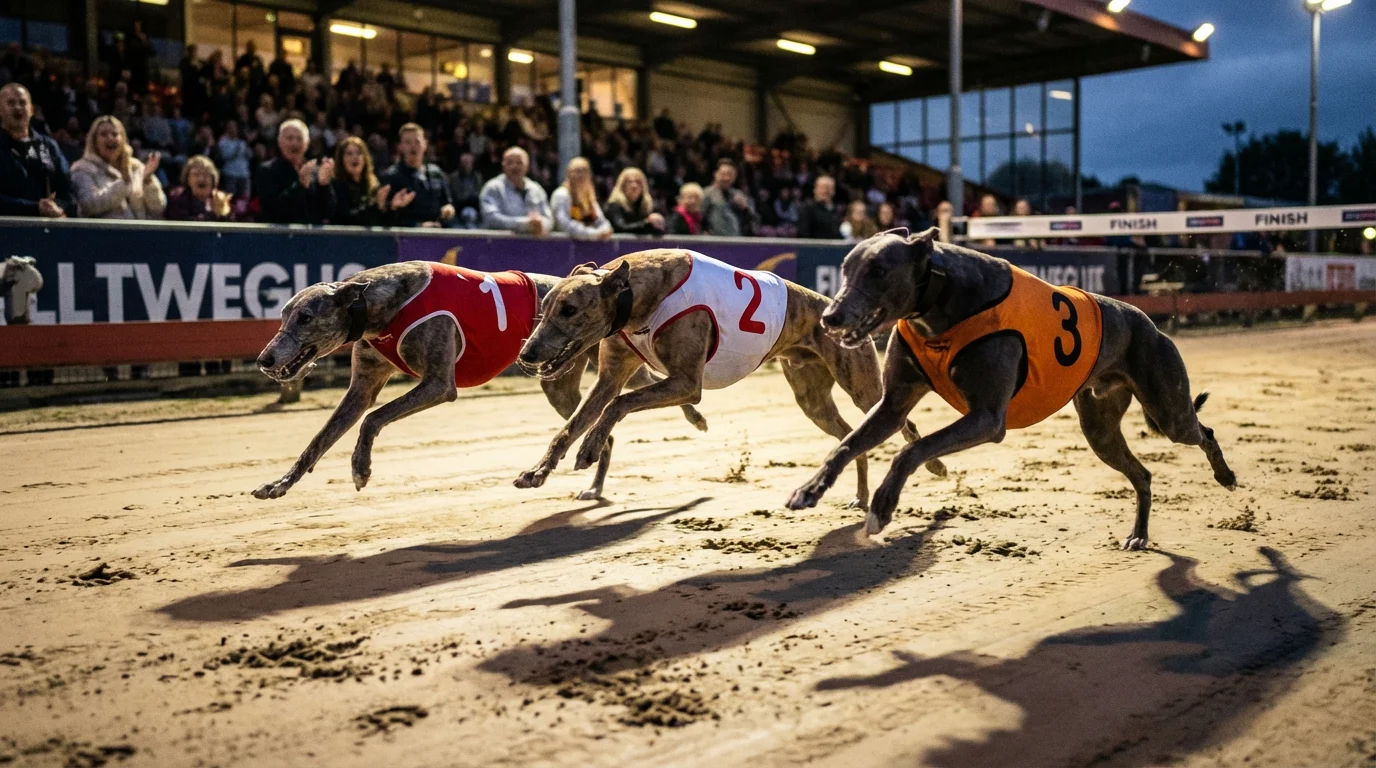
Best Greyhound Betting Sites – Bet on Greyhounds in 2026
Loading...
What Is a Tricast Bet?
Three dogs, exact order, maximum difficulty. A tricast bet requires you to predict the first, second, and third finishers in a greyhound race, in precisely that sequence. Get the right three dogs but in the wrong order and you lose. It is the hardest standard bet type in greyhound racing, and the payouts reflect that challenge.
In a six-runner race at Monmore, there are 120 possible finishing permutations for the first three positions. A win bet asks you to identify one dog out of six. A forecast asks for two out of six in order — 30 combinations. A tricast demands one correct sequence out of 120. The probability arithmetic is unfriendly, which is exactly why tricast dividends can be spectacularly large when the result includes one or more outsiders.
Tricast bets are available through all major UK bookmakers and through the on-course tote at Monmore. The payout is typically determined by the Computer Tricast formula, which calculates a return based on the Starting Prices of the first three finishers. Some bookmakers also offer fixed-price tricasts, where you can see the potential return before the race — these are priced by the operator’s trading team and may differ from the Computer Tricast dividend.
The fundamental question with any tricast is whether the additional difficulty relative to a forecast or a win bet is compensated by the additional return. Picking the first two in order is hard enough. Adding the third finisher into the equation multiplies the permutations by a factor of four and introduces a layer of uncertainty that form analysis can only partially resolve. The third-place finisher in a greyhound race is often decided by half a length or less — margins so tight that luck, interference, and running lines matter as much as raw ability.
Full Tricast vs Combination Tricast
One combination costs one stake. Six combinations cost six. The choice between a full tricast and a combination tricast is fundamentally a question of how confident you are about the finishing order — not just the three dogs, but the exact sequence in which they cross the line.
A full tricast is a single bet on a single permutation: Dog A first, Dog B second, Dog C third. One stake, one chance. If those three dogs finish in any other order — even if they still occupy the first three places — the bet loses. This is the purest and cheapest form of tricast betting, and it demands genuine conviction about the running order.
A combination tricast covers every possible ordering of your three selected dogs. With three dogs, there are six permutations: ABC, ACB, BAC, BCA, CAB, CBA. Each permutation is a separate bet, so a combination tricast costs six times the unit stake. If your three dogs fill the first three positions in any order, one of the six permutations will be correct and you collect. The other five bets lose, but the winning dividend usually covers them comfortably — particularly if one or more of your selections is at a longer price.
The strategic consideration is cost versus confidence. If you’ve identified three dogs that you believe will dominate a race but you genuinely can’t separate the likely winner from the runner-up and third, the combination tricast is the rational choice. You’re paying six stakes to remove the ordering risk. If, on the other hand, your form analysis points clearly to one dog as the winner and you have a reasonably strong view on the second and third, the full tricast preserves your margin — one stake for one outcome, with a potential return that isn’t diluted by five losing legs.
There is a middle option that some punters use: a partial combination, or banker tricast. In this format, you nominate one dog as the definite winner and combine the other two in either order for second and third. That gives you two permutations instead of six, at twice the unit stake. It’s a useful compromise when you have high conviction on the winner but less certainty about the finishing order behind.
Typical Tricast Payouts at Monmore
Three outsiders in order? That’s a four-figure return. The range of tricast payouts at Monmore is enormous, and understanding where on that spectrum a particular race is likely to land can help you decide whether the bet is worth the stake.
At the low end, a tricast where three well-fancied dogs finish in market order — favourite first, second favourite second, third favourite third — might return between 10 and 30 pounds to a one-pound stake. These results are rare in their exact sequence but not particularly surprising in their composition, and the market has priced them accordingly. The Computer Tricast formula, which calculates the dividend from the SPs of the first three finishers, produces modest returns when all three SPs are short.
The returns escalate quickly as longer-priced dogs enter the frame. If the winner is the 3/1 favourite but the second and third finishers were both priced at 8/1 or longer, the tricast dividend might reach 100 to 300 pounds. When the winner itself is an outsider — 10/1 or above — and the minor placings are also filled by unconsidered dogs, the return can push into four figures. These results don’t happen every meeting, but they happen often enough across a season of Monmore racing to keep tricast bettors interested.
The tote tricast, calculated from the pool rather than the CSF formula, can produce different returns depending on betting patterns. On a Saturday evening with a large on-course crowd, a popular tricast combination might return less through the tote than the Computer Tricast, because more winning tickets share the pool. On a quiet afternoon meeting where few punters attempted the tricast at all, the tote return can exceed the Computer Tricast significantly. The variability makes the tote tricast attractive for contrarian bettors who believe their selection is unlikely to be widely held.
One useful reference point: the average Computer Tricast dividend across all UK greyhound racing hovers between 80 and 150 pounds per one-pound stake, depending on the dataset. At Monmore specifically, the figures fluctuate around that range. It’s not a fixed number — every race is different — but it gives you a baseline expectation against which to judge whether a particular tricast opportunity is worth pursuing.
Tricast Strategy: When the Risk Is Worth It
The tricast is not a lottery ticket. Treating it as one — throwing a pound at every race and hoping for a windfall — is a reliable way to grind your bankroll down to nothing. The difficulty of predicting three finishers in order means most tricast bets lose, and the returns on the occasional winner need to be large enough to cover the accumulated losses. That only works if you’re selective about which races you target.
The best tricast opportunities at Monmore share certain characteristics. First, the race should have a form profile where three dogs are clearly distinguishable from the rest of the field. This doesn’t mean they need to be the three shortest-priced runners — in fact, the best tricast value often comes from including a dog that the market has overlooked. But you need three dogs whose recent form, trap draws, and running styles suggest they’ll fill the first three positions, with the remaining runners unlikely to intrude.
Second, the finishing order should be at least partially readable from the form. If one of your three dogs is a confirmed front-runner with strong early pace and a favourable inside draw, that dog is a reasonable banker for first place. If another is a consistent closer who tends to pick up places in the final 50 metres, that dog fits the third-place slot. Races where the run styles of your selected dogs map naturally onto the first, second, and third positions are better tricast targets than races where all three runners have similar styles and could finish in any sequence.
Third, the expected return needs to justify the risk. A tricast on three short-priced dogs that returns 15 pounds is a poor bet, because the difficulty of the prediction is not compensated by the payout. If you can identify a tricast combination that includes at least one dog at 5/1 or longer, the potential Computer Tricast dividend starts to enter territory where the reward justifies the probability of failure. The sweet spot for regular tricast betting is races where your selection includes a solid favourite, a mid-priced contender, and one longer-priced runner whose form suggests it has a genuine chance of filling a place.
Staking should reflect the low strike rate. Experienced tricast bettors at Monmore typically use small, consistent stakes — one or two pounds per bet — and accept that most bets will lose. The discipline is in the selection, not the staking. A well-chosen tricast that lands once in twelve attempts can still be profitable if the average return on the winners exceeds the twelve-unit outlay. That maths only works if you’re selective, patient, and honest about which races genuinely offer a readable finishing order rather than wishful thinking dressed up as analysis.