 Monmore dogs
 Greyhound Racing Calendar: Key UK Events and Dates
 Available in US
UK greyhound racing calendar with key events and dates. Major competitions including the Derby, Oaks and Gold Cup, Monmore highlights and calendar-based betting planning.
The UK Greyhound Racing Season
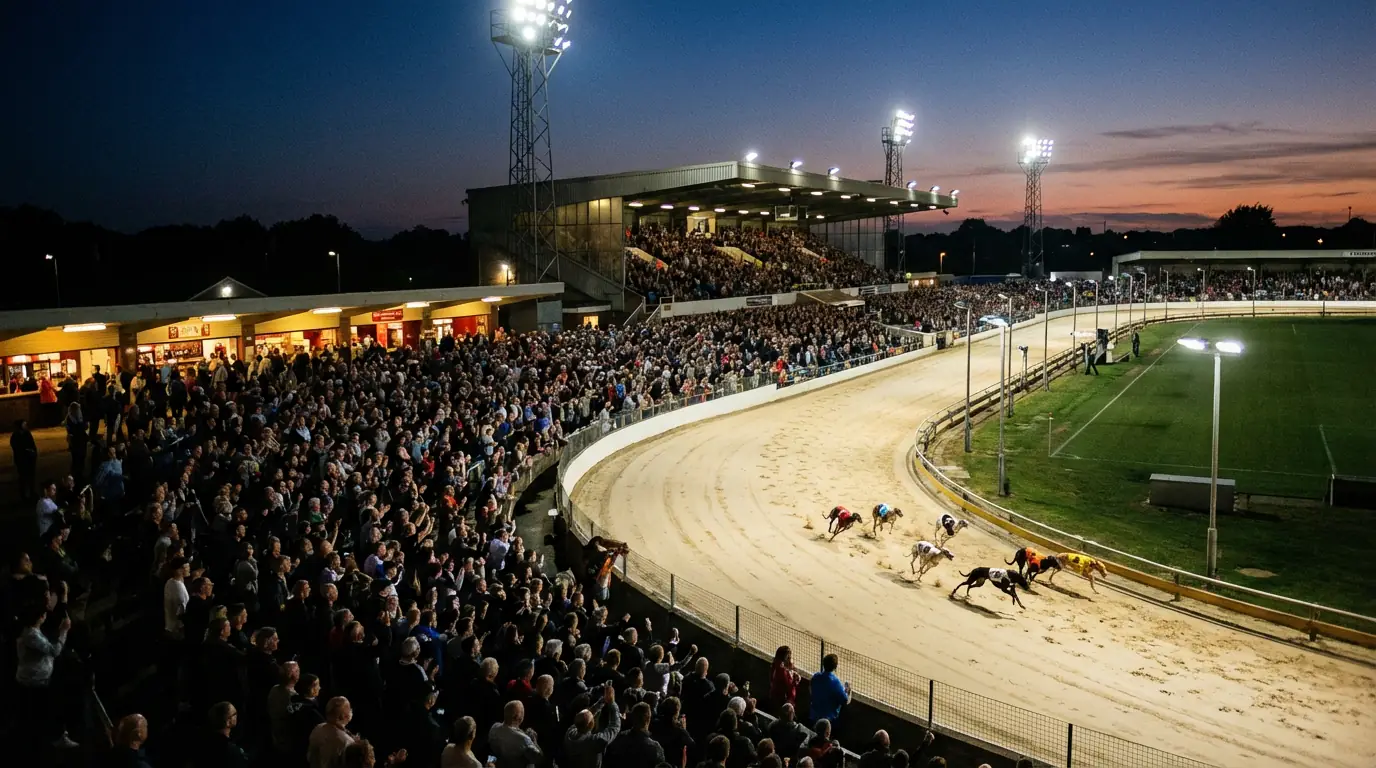
There’s no off-season — but there is a rhythm. Unlike horse racing, which has distinct flat and jumps seasons with defined start and end points, greyhound racing in Britain operates year-round. Licensed tracks run meetings every week, from January through December, with no extended break. But within that continuous schedule, the racing year has its own patterns, peaks, and quiet stretches that shape the competitive landscape.
The early months of the year — January through March — tend to be a consolidation period. Trainers are managing their kennels through the winter, and the going at sand tracks like Monmore can be variable as cold weather and rain affect surface conditions. Major competitions are fewer during this stretch, and the racing programme leans more heavily on regular graded meetings and BAGS fixtures. It’s a period when form data accumulates steadily but the headline events are sparse.
Spring and summer bring the peak of the calendar. The major national competitions — the English Greyhound Derby, the Oaks, the St Leger, and the Gold Cup at various venues — are concentrated between April and October. This is when the fastest dogs are aimed at the biggest prizes, when ante-post betting markets are at their most active, and when the sport attracts its widest audience. Evening meetings benefit from longer daylight and warmer weather, and the going tends toward fast, producing the quickest times of the year.
Autumn sees the calendar wind down from the summer peak, with the final major competitions running through September and October. November and December shift the focus back to regular fixtures, with the notable exception of the Christmas and New Year period, which produces some of the best-attended meetings of the entire year. Boxing Day racing is a tradition at most UK tracks, and the festive programme often includes enhanced grading and special events that draw larger-than-usual crowds.
Major Competitions: Derby, Oaks, Gold Cup
The English Greyhound Derby sits at the top. It is the single most prestigious event in UK greyhound racing — the race that every owner, trainer, and breeder targets, and the one that defines a generation of dogs. The Derby is contested over 500 metres, traditionally at a flagship London track but now held at Towcester Racecourse, and its roll of honour reads like a history of the sport’s greatest performers. Winning the Derby elevates a dog from fast to famous, and the ante-post betting market for the competition is the deepest and most closely followed in greyhound racing.
The English Greyhound Oaks is the Derby’s female counterpart, restricted to bitches and typically staged at the same venue on the same week or fortnight. The Oaks carries significant prestige and its own dedicated betting market, though it generates less public attention than the Derby. For punters, the Oaks offers a slightly less scrutinised market where value can be easier to find, precisely because the spotlight is predominantly on the open-sex competition.
The St Leger, traditionally a staying event, tests greyhounds over a longer distance than the Derby and rewards stamina as well as speed. It sits a tier below the Derby in terms of public profile but carries genuine weight within the sport. Other national competitions include the Cesarewitch, the Champion Stakes, and various category-specific events like Puppy Derbies and veteran competitions that celebrate different stages of a greyhound’s career.
Regional competitions — like the Ladbrokes Gold Cup at Monmore — fill the calendar between the national flagship events. These races carry local prestige, attract the best dogs from the surrounding kennel population, and provide both competitive focus and betting interest throughout the year. For punters based in the Midlands, Monmore’s own calendar of feature events is as relevant to their regular betting as the national Derby is to the sport’s broader audience.
Monmore’s Calendar Highlights
Five named events anchor the Wolverhampton schedule. Monmore Green’s competitive year is structured around a series of feature competitions that punctuate the regular graded programme, each drawing higher-quality fields and larger crowds than the standard weekly meetings.
The Ladbrokes Gold Cup is the flagship — Monmore’s most prestigious race, contested over 480 metres in open class. It attracts entries from across the Midlands and occasionally beyond, and its final, staged on a Saturday evening, is the highest-profile night on the Monmore calendar. The Gold Cup has its own ante-post market that opens when entries are published, and the heat-to-final format provides multiple betting opportunities across two weekends.
The Puppy Derby targets younger greyhounds — dogs in the early stages of their racing careers — and provides a showcase for the next generation of Monmore talent. The stakes are different from the Gold Cup: rather than established open-class performers, the Puppy Derby features developing dogs whose ceilings are still unknown. For punters, this means more uncertainty but also more potential value, as the market has less historical data on which to base accurate pricing.
The Trafalgar Cup, the Champion Stakes, and seasonal feature events round out the programme. Each carries its own distance, entry criteria, and competitive character. Together, they ensure that Monmore’s calendar has a focal point roughly once a month during the busiest part of the year, giving trainers targets for their strongest dogs and giving punters event-specific markets that sit above the standard weekly graded programme.
The schedule for these events is published on the Monmore Green website and through the GBGB fixture list, typically well in advance. Marking these dates in your calendar is a practical step for any regular Monmore bettor, because the feature events produce the strongest fields, the deepest markets, and the best-quality form data of the entire racing year.
Using the Calendar for Betting Planning
Big events mean ante-post markets and early prices. The existence of a structured competitive calendar at Monmore — and across UK greyhound racing more broadly — gives punters something that the weekly graded programme does not: advance planning opportunities.
When a major competition like the Gold Cup is announced, bookmakers open an ante-post market on the outright winner. These markets are priced before the heat draws are made, before the going is known, and before the dogs have been seen in their pre-competition trials. The uncertainty embedded in ante-post prices makes them inherently more generous than the odds available on the night of the final, because the market is pricing risk as well as form. Punters who have done their homework on the likely entries — tracking form, fitness, and trainer patterns in the weeks before the event — can find value at this stage that disappears once the market has more information.
Calendar awareness also helps with bankroll planning. If you know that a feature event is two weeks away, you can allocate a portion of your betting budget specifically for that weekend — reserving funds for the ante-post phase, the heats, and the final. This prevents the common mistake of arriving at a major event with a depleted bankroll because the preceding weeks of regular betting consumed the funds you intended for the bigger occasion.
Seasonal patterns in the calendar affect form analysis too. Dogs that have been trained to peak for a summer Gold Cup will be at the top of their fitness cycle in July and August but may show a natural dip in form during the autumn and winter. Trainers who target the Christmas programme will manage their preparation differently, peaking their dogs for December rather than midsummer. Understanding where each dog sits in its competitive cycle — and relating that to the calendar’s feature events — adds a temporal dimension to form analysis that many punters neglect.
The calendar is, in effect, a roadmap for the racing year. The punters who use it to plan their betting — targeting the right events, managing their budget around the peaks, and timing their form study to coincide with the competitions that matter most — approach the sport with a structure that casual bettors lack. That structure doesn’t guarantee profit, but it organises the effort in a way that makes profitable betting more achievable.
Follow the greyhound racing calendar on the monmoredogsresults homepage.
Check Monmore’s specific race schedule in race schedule.
