 Monmore dogs
 Tote and Pool Betting on Greyhounds Explained
 Available in US
How tote and pool betting works at greyhound racing. Win, place and exacta pools explained, tote vs bookmaker value comparison, and how to bet tote at Monmore Green.
What Is Tote Betting at the Dogs?
The tote pools everyone’s money and divides the returns. Unlike a fixed-odds bet with a bookmaker, where the price is agreed at the moment you place the bet, tote betting operates on a pari-mutuel system. All bets on a particular outcome are collected into a pool. After the race, the pool is divided among the winning ticket holders, minus a percentage deducted by the tote operator. The dividend — the return per unit staked — is only known after the race is over.
This means that when you place a tote bet at Monmore, you don’t know what your return will be if you win. You know the structure of the bet — win, place, forecast — but the actual payout depends on how much money has been bet into the pool and how many other punters have backed the same outcome. A heavily backed favourite might return less through the tote than its fixed-odds Starting Price, because many winning tickets share the pool. An overlooked outsider might return significantly more, because fewer winners share a larger pool.
Tote betting has a long history in UK greyhound racing. Before the proliferation of licensed bookmakers, the tote was the primary on-course betting method at tracks like Monmore. Today, the tote operates alongside fixed-odds bookmakers both at the track and online, giving punters a choice of systems for every race. The two methods coexist, and many experienced bettors use both — choosing between tote and bookmaker based on whichever is likely to offer the better return for a specific race.
The tote’s appeal is its simplicity at the point of betting. You don’t need to compare prices, evaluate bookmaker margins, or worry about your odds shortening between placing the bet and the race starting. You back a dog, and if it wins, you share the pool. The uncertainty about the exact return is the trade-off for that simplicity.
Tote Win, Place and Exacta Pools
Three pools, three calculations, three payout methods. The tote at Monmore operates several distinct pool types, each with its own structure and its own dividend calculation. Understanding which pool applies to your bet is essential for knowing what you’re getting into.
The Win pool is the most straightforward. All bets on the winner of a race are collected, the tote’s deduction is subtracted, and the remainder is divided equally among all winning tickets. If the Win pool totals a thousand pounds, the deduction is 15%, and fifty tickets backed the winner, each winning ticket receives 850 divided by 50 — seventeen pounds per one-pound unit. The deduction percentage varies but typically falls between 13% and 16% for UK tote operations.
The Place pool works on the same principle but pays out on dogs that finish in a place position — typically the first two in a six-runner race. Each place finisher has its own sub-pool, and the dividends for first and second can differ depending on how the betting money was distributed. A dog that attracted a lot of place money returns less per ticket than a dog that attracted very little. This is why tote place returns can surprise: an outsider that places might produce a significantly larger tote dividend than the bookmaker’s place terms would have paid.
The Exacta pool — the tote equivalent of a straight forecast — requires you to predict the first and second finishers in the correct order. The pool collects all exacta bets for the race, and the dividend is shared among those who correctly predicted the finishing order. Because exacta pools tend to be smaller than win pools, and the outcome is harder to predict, the returns can be substantial. A well-judged exacta on a less obvious combination can return significantly more through the tote than the Computer Straight Forecast paid through the bookmaker — though the reverse is equally possible.
Trifecta pools — requiring the first three in order — operate at some tracks and on some platforms, following the same pooling principle extended to three finishers. The pools are smaller still, the predictions harder, and the potential dividends larger.
Tote vs Bookmaker: Which Gives Better Value?
Sometimes the tote pays more. Sometimes the bookmaker does. There is no universal answer, and anyone who tells you that one system is always better than the other hasn’t looked at the data carefully enough.
The tote tends to offer better value when the winning dog was not heavily backed. Because the tote dividend is calculated from the pool rather than from fixed odds, an outsider that wins when most of the pool money was on other dogs produces a large return. In that scenario, the tote dividend often exceeds the bookmaker SP return, because the pool amplifies the returns on lightly backed runners. This is the tote’s structural advantage: it rewards contrarian selections more generously than fixed-odds markets typically do.
The bookmaker tends to offer better value on favourites and well-supported runners. When a heavily backed dog wins, the large number of winning tote tickets dilutes the pool, and the dividend per ticket can be lower than the fixed-odds SP. The bookmaker, who set a price before the race, might pay 2/1 when the tote returns only 1.80 to a one-pound stake. For punters who consistently back short-priced selections, fixed odds typically provide more predictable and often superior returns.
The overround applies differently in each system. A bookmaker’s overround is built into the prices at the point of publication. The tote’s deduction is a flat percentage taken from the pool before dividends are calculated. In a race where the bookmaker’s overround is high — 18% or more — the tote’s flat deduction of 13-15% might actually represent a better deal. In races with competitive bookmaker margins, the fixed-odds market might be more efficient.
The practical approach is to compare retrospectively. After a few weeks of betting at Monmore, review which system — tote or bookmaker — would have produced better returns on your actual selections. You may find that your selection style favours one system over the other. Punters who frequently back outsiders and longer-priced contenders often find the tote more rewarding. Those who back favourites and short-to-mid-priced runners usually do better with fixed odds.
How to Bet Tote at Monmore Green
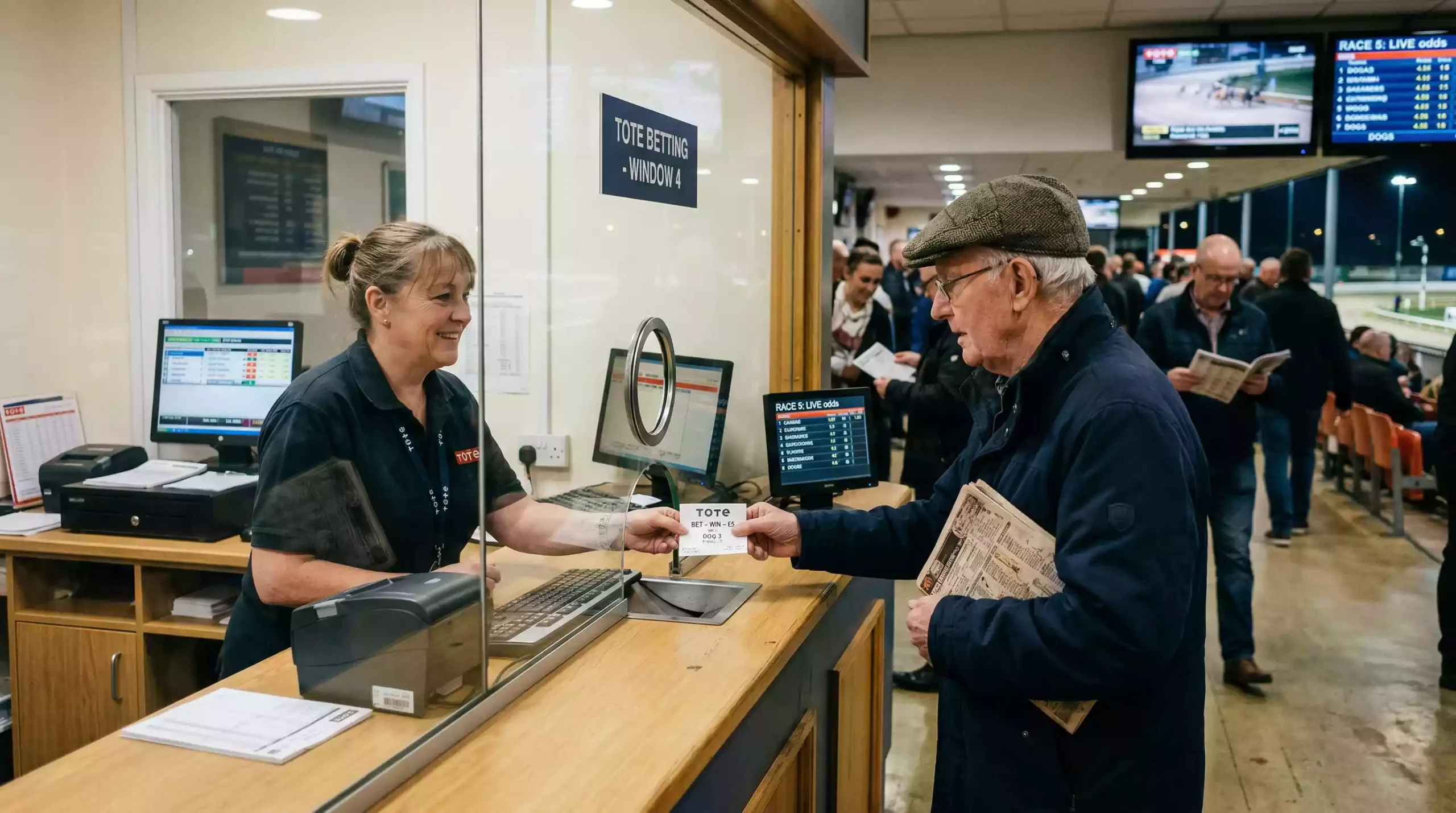
On-course tote windows are open from the first race. At Monmore, the tote operates through physical windows on all three levels of the stadium, staffed by operators who accept cash bets and issue printed tickets. The process is simple: tell the operator your bet type (win, place, exacta), the trap number of your selection, and your stake. You receive a ticket. If your bet wins, you return to the window with the ticket and collect your dividend.
Minimum stakes on the on-course tote are low — typically one or two pounds — making it accessible for casual visitors who want to have a few bets without committing large amounts. The tickets show the bet type, the selection, and the stake, but not the potential return, because the dividend hasn’t been calculated yet. You find out what you’ve won after the race, when the tote dividend is announced over the PA system and displayed on screens around the stadium.
For punters who prefer not to queue at the windows, some tote bets can also be placed through mobile platforms. Certain bookmakers integrate tote pools into their apps, allowing you to bet into the same pool from your phone as you would at the window. The returns are identical — you’re contributing to the same pool regardless of whether the bet originates at the counter or through the app.
One practical advantage of tote betting at the track is that the tote doesn’t limit winning accounts. Fixed-odds bookmakers are known for restricting or closing the accounts of consistently profitable customers. The tote, as a pool system, has no mechanism or incentive to restrict individual bettors — your winnings come from the pool, not from the operator’s liability. For punters who have experienced bookmaker restrictions, the on-course tote at Monmore provides an unrestricted betting channel that is always available on race nights.
Collecting winnings from the tote is cash-in-hand at the track. Present your winning ticket at any open tote window, and the operator pays the dividend immediately. There are no processing delays, no pending withdrawals, and no identity verification for standard amounts. For many regular Monmore attendees, the immediacy and simplicity of the tote experience is as much of the appeal as the potential returns.
Find all tote and pool betting guides on the monmoredogsresults homepage.
Compare with accumulator bets in accumulator bets.
