 Monmore dogs
 Greyhound Trainers at Monmore Green: Profiles and Stats
 Available in US
Guide to greyhound trainers at Monmore Green. Trainer roles, kennel profiles, reading trainer statistics and using trainer form as a betting factor at Monmore.
The Role of the Trainer in Greyhound Racing
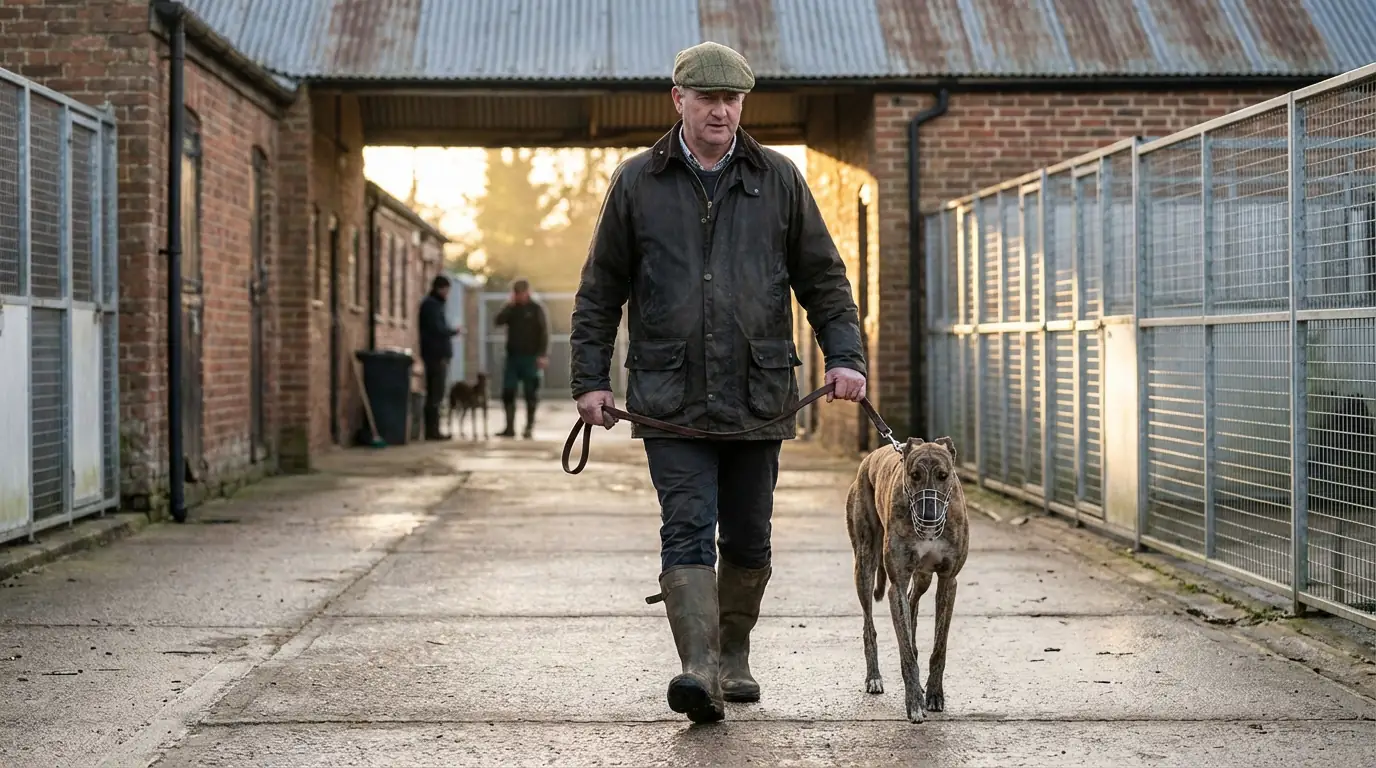
The trainer decides when a dog runs, where it runs, and at what distance. In greyhound racing, the trainer is the single most influential figure in a dog’s competitive life — more so than in most other sports, because the greyhound has no jockey, no tactical instructions during the race, and no ability to adjust its own preparation. Every decision about the dog’s fitness, readiness, and racing plan is made by the trainer before the traps open.
At Monmore, trainers licensed by the GBGB manage kennels that typically house between five and thirty dogs, depending on the size of the operation. The trainer is responsible for the day-to-day care of each dog — feeding, exercise, injury management, and conditioning — as well as the racing strategy: which meetings to enter, which distances to target, and when to rest a dog between races. A trainer who enters a dog in a 480-metre A5 race on Tuesday afternoon rather than a 630-metre A4 race on Thursday evening has made a decision about the dog’s best chance of winning, based on knowledge of the dog’s abilities, the likely opposition, and the track conditions.
Trial sessions are another part of the trainer’s toolkit. Before a dog appears on a Monmore racecard, it will have completed trial runs at the track — timed runs over race distance that allow the trainer and the racing office to assess the dog’s speed and fitness. Trial times influence the initial grading when a dog first races at Monmore, and subsequent trials after injury or a break from racing determine when and at what grade the dog returns.
The trainer also manages the relationship between the dog and the track. Some greyhounds perform better at certain venues than others, and an experienced trainer learns which of their dogs suit Monmore’s 419-metre circuit, its 103-metre first-bend run, and its sand surface. Placing dogs at tracks where their running style and physical profile are best rewarded is a skill that separates the most successful trainers from the rest.
Key Trainers Based at Monmore
Some names appear on the card more than others. At any given Monmore meeting — afternoon or evening — a handful of kennels will have multiple runners across the programme, and over weeks and months, certain trainers emerge as the dominant forces at the track.
The Monmore training population is anchored by several established kennels that have been racing at the stadium for years. These are operations built around deep knowledge of the track: how the surface rides in different weather, which traps favour which types of dogs at each distance, and how the racing office grades the local population. That accumulated institutional knowledge gives long-established trainers an advantage that newer arrivals at the track cannot easily replicate.
The size of a kennel matters but is not the only indicator of quality. A large kennel with twenty-five dogs will have more runners per meeting, which naturally produces more winners in absolute terms. But a smaller kennel with ten dogs, managed by a trainer who places each one precisely, might have a higher win rate per runner — a more meaningful metric for punters assessing trainer quality.
Visiting trainers also feature on Monmore racecards, particularly for evening meetings and feature events. Trainers based at other Midlands tracks or even further afield may enter dogs for the Ladbrokes Gold Cup, the Puppy Derby, or open-grade races that carry higher prize money. These entries add competitive depth to the programme but also introduce an element of uncertainty: dogs from outside kennels may have limited form at Monmore, making their likely performance harder to assess.
The practical approach for punters is to track trainer performance at Monmore specifically, rather than relying on reputation alone. A trainer with a strong national profile might underperform at Monmore if their dogs don’t suit the track, while a local trainer with no national profile might quietly produce the best strike rate at the venue. The data is available in the results archive — it just needs to be filtered by trainer and compiled over time.
Reading Trainer Statistics
Win rate by grade tells you more than total winners. A trainer who sends 200 dogs to the start over a month and produces 30 winners has a 15% strike rate. A trainer who sends 50 and produces 12 has a 24% strike rate. The second trainer is placing dogs more effectively, even though the first has more total winners. For betting purposes, the rate matters more than the volume, because the rate reflects the quality of the trainer’s decision-making about when and where to run each dog.
Segmenting trainer statistics by grade adds another layer of insight. A trainer might show a 25% win rate in A6 and A7 races but only 8% in A3 and above. That pattern tells you the kennel is strongest in mid-grade company — the dogs are well placed at that level but struggle against higher-class opposition. When you see that trainer’s dog on an A6 racecard, the statistics support the selection. When the same trainer runs a dog in an A3 race, the statistics suggest caution.
Distance-specific trainer performance is equally revealing. Some kennels specialise in sprint dogs, consistently producing fast 264-metre runners. Others focus on the standard distance or on staying events. A trainer whose dogs win at 480 metres at a higher rate than at 630 metres has a kennel profile biased toward speed rather than stamina. Matching the trainer’s strengths to the race distance is a simple filter that many punters overlook.
Timeframe matters when assessing trainer statistics. A trainer’s career record at Monmore is interesting but may not reflect current form. A three-month rolling window is more useful for betting purposes, because it captures the current quality of the kennel’s dog roster, the trainer’s recent conditioning methods, and the seasonal patterns that affect all trainers differently. A kennel that was dominant last winter might be rebuilding through the summer after key dogs retired. The current form, not the historical record, drives the next result.
Trainer Form as a Betting Factor
A hot kennel can stay hot for weeks. Trainer form in greyhound racing follows streaks in a way that individual dog form does not, and recognising when a kennel is in a productive cycle is one of the more reliable supplementary indicators available to Monmore punters.
The reason trainer form clusters into streaks is practical rather than mystical. When a kennel is in form, it usually means several things are aligned simultaneously: the dogs in the kennel are fit and healthy, the trainer’s conditioning regime is producing peak performances, and the trainer is placing dogs in races where they’re competitively suited. These factors reinforce each other. A fit kennel produces winners, which gives the trainer confidence to enter dogs in slightly more ambitious races, which produces more winners if the dogs are good enough. The cycle sustains itself until something breaks it — a run of injuries, a change in the kennel roster, or a natural regression from an unusually productive period.
The reverse is also true. A kennel in a cold streak might be dealing with illness running through the dogs, a key performer retiring, or simply a patch where the racing office’s grading decisions have been unfavourable. Cold streaks, like hot ones, tend to persist for a period before reversing.
For betting purposes, the simplest method of tracking trainer form is to note the winners from each Monmore meeting and tally them by trainer over a rolling two-to-three-week period. A trainer producing four or five winners per week is on a hot streak that warrants attention. A trainer who hasn’t had a winner in two weeks is in a cold phase that suggests caution when backing their runners.
Trainer form should be used as a supporting factor rather than a primary selection criterion. A dog with poor recent form from a hot kennel is not automatically a good bet — the individual form still comes first. But when you’ve identified a selection based on form, trap draw, and distance suitability, and you notice that the trainer is in a productive cycle, that additional data point strengthens the case. It doesn’t create the edge. It confirms it.
Research Monmore greyhound trainers on the monmoredogsresults homepage.
Combine trainer knowledge with form analysis in form analysis.
