 Monmore dogs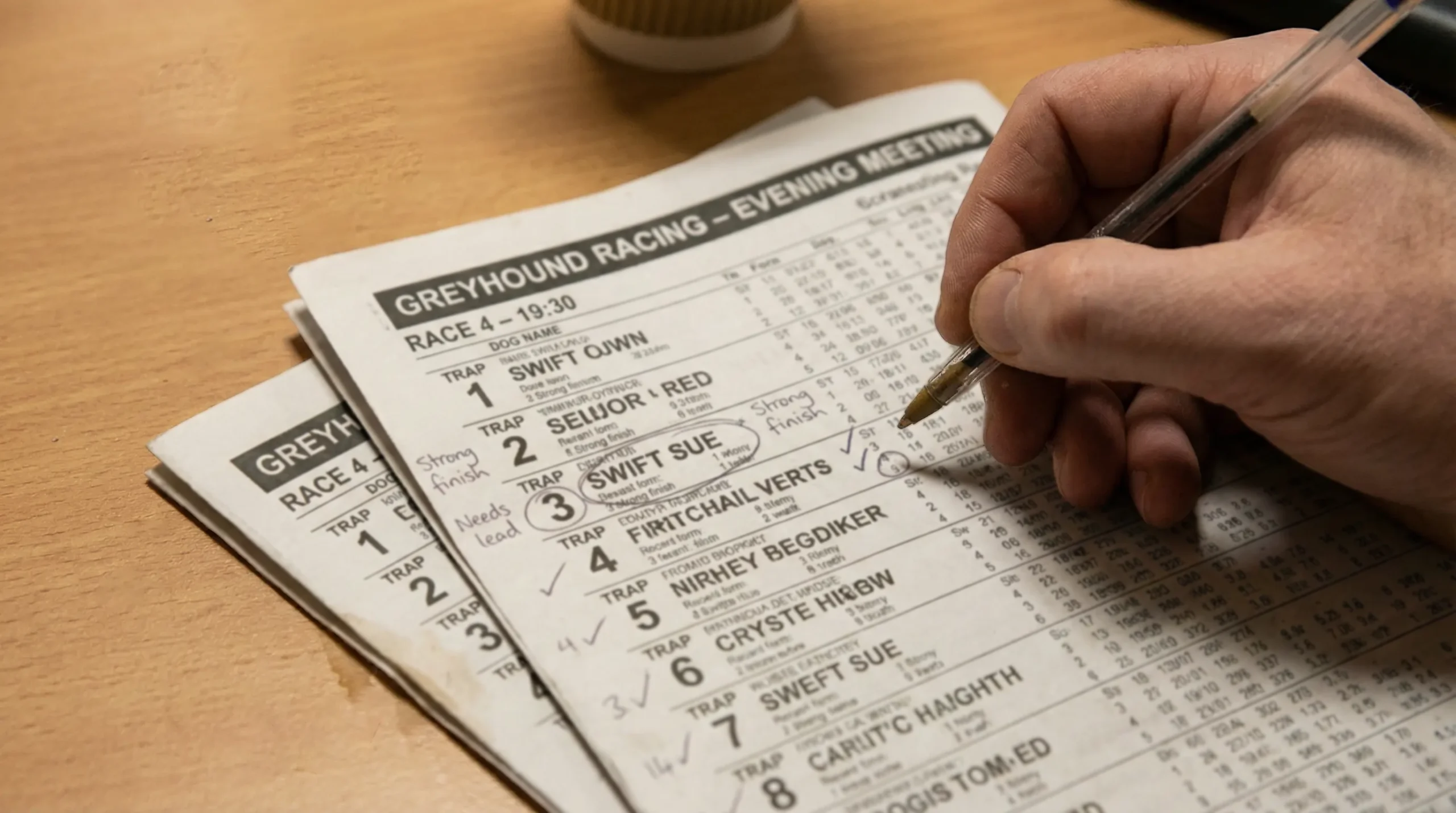
Best Greyhound Betting Sites – Bet on Greyhounds in 2026
Loading...
Where to Find Monmore Racecards
The racecard is the starting point for every bet you place at Monmore. It lists the runners, their trap draws, recent form, weights, trainers, and the essential data you need to assess a race before the odds even enter the picture. Knowing where to find reliable racecards — and understanding which sources give you the most useful information — is the first practical skill any Monmore punter needs to develop.
The GBGB website publishes official racecards for all licensed UK greyhound meetings, including every fixture at Monmore Green. These cards carry the confirmed runners, trap draws, and basic form figures. They are accurate and authoritative, because the GBGB is the governing body responsible for the sport, and the data comes directly from the racing office. The limitation is that official GBGB racecards tend to be sparse — you get the facts, but not the analysis or the depth of form data that more specialist platforms provide.
Timeform is the premium option for greyhound racecards in the UK. Their cards include detailed form lines, speed ratings, sectional times, trainer statistics, and predicted finishing positions generated by their proprietary algorithm. Timeform’s data is the deepest available to the public, and for regular Monmore punters who want to make informed selections rather than rely on instinct, it is the most useful single source. Access to the full Timeform racecard requires a subscription, though some data is available through bookmaker partnerships.
At The Races and the Racing Post both publish greyhound racecards that sit between the GBGB’s bare-bones offering and Timeform’s full analysis. These platforms include form lines, recent results, and basic statistics, and they are freely accessible online. For punters who want more context than the official card provides but aren’t ready for a Timeform subscription, these are solid intermediate options.
Oddschecker displays racecards alongside real-time odds from multiple bookmakers, making it the natural choice if your primary goal is comparing prices across the market rather than deep form analysis. The racecard information on Oddschecker is functional rather than detailed — you’ll see trap draws, form figures, and basic information, but not the sectional times or speed ratings that specialist platforms offer.
Most major bookmakers — Bet365, Ladbrokes, Coral, William Hill, Betfair — also publish racecards for Monmore meetings within their platforms. The depth of information varies by operator. Some integrate Timeform data directly into their racecard pages, giving you form analysis alongside the betting interface. Others provide only the minimum data required to identify the runners and place a bet. If your bookmaker’s racecard is thin on detail, use it for placing bets but do your analysis elsewhere.
Print Versus Digital Racecards
The choice between print and digital racecards is partly practical and partly about how you prefer to process information. Both formats deliver the same core data — runners, traps, form, weights, trainers — but the experience of using them differs in ways that matter for regular punters.
Print racecards are available at the track on race nights. They provide a physical document you can hold, annotate, and refer to between races without needing a screen. For punters who attend Monmore in person, the printed card is part of the ritual: circling selections, noting weights, jotting observations in the margins. The tangible format encourages a slower, more deliberate assessment of each race, which can be an advantage over the rapid scrolling that digital platforms promote.
The limitation of print is currency. A printed racecard is fixed at the moment of publication. It cannot update to reflect a late withdrawal, a trap change, or a going report issued after the card was printed. At the track, announcements over the public address system cover these changes, but punters relying solely on the printed card need to stay alert to amendments.
Digital racecards update in real time. A withdrawal is reflected within minutes, the going report appears as soon as it’s issued, and odds movements are visible as the market develops. For punters betting remotely — which is the majority of Monmore’s audience on afternoon BAGS fixtures — the digital racecard is the only practical option. The trade-off is that screens encourage rapid consumption rather than careful study, and the temptation to flip between races, check odds, and place bets simultaneously can dilute the quality of your analysis.
The practical solution for many experienced punters is a hybrid approach. Use the digital racecard for its real-time data — updated form, going reports, market movements — but process the information with the same deliberation you’d apply to a printed card. Some punters print the digital racecard at home and annotate it by hand, combining the currency of digital data with the focused workflow of a physical document. Others use a notes app on their phone to record assessments alongside the digital card. The format matters less than the discipline: whatever medium you use, the goal is to assess each race thoroughly before engaging with the betting market.
Making Notes on Racecard Margins
The racecard is not a finished product — it’s a worksheet. The most productive punters treat the racecard as a starting point for their own analysis, adding notes, marks, and observations that transform raw data into actionable assessments. Whether you write on a printed card or type into a digital note, the habit of annotating the racecard is what separates systematic punters from casual ones.
Start with the form figures. Each dog’s recent results are listed as a sequence of finishing positions — 1 3 2 4 1 2, for example. These numbers tell you what happened but not why. Your job is to add the why. Check the run comments for each recent race: did the dog lead early and fade, or was it slow away and finished strongly? Was it crowded at the first bend or did it have a clear run? The answers to these questions, noted in shorthand beside the form figures, give you a richer picture of the dog’s recent racing than the raw numbers alone.
Mark the trap draw in relation to each dog’s running style. A railer drawn in Trap 1 has a natural advantage — note it with a positive mark. A wide runner drawn in Trap 1, where it will need to cross the field to reach its preferred racing line, faces a disadvantage — note that too. This trap-style interaction is one of the most consistently useful form angles at Monmore, where the 103-metre run to the first bend compresses the sorting process and amplifies the importance of early positioning.
Note weight changes. If a dog has dropped half a kilogram since its last run, that might indicate sharpening fitness. If it has gained a full kilogram, that’s worth flagging as a potential concern. Weight data is on the racecard but its significance only becomes clear when you compare it to the dog’s recent history, which requires looking beyond tonight’s card to the form archive.
Finally, mark your assessment of each race before you look at the odds. Identify which dogs you rate as contenders, which you consider unlikely winners, and which are borderline cases. Write these assessments down. Then, and only then, check the market. If a dog you’ve rated as a strong contender is available at a price that exceeds your assessment of its chance, that’s a potential bet. If every dog you rate is at a short price, the race may not offer value and is one to skip. The racecard, annotated with your analysis, becomes the filter that the betting market passes through — and the quality of your annotations determines the quality of your decisions.
A Four-Step Racecard Workflow
Read, rank, eliminate, bet. That four-word sequence is the most efficient workflow for turning a Monmore racecard into a betting plan, and it works whether you’re analysing a single race or working through an entire evening card.
Step one is to read every runner in the race. Not the one you fancy, not the favourite, not the dog with the catchy name — every runner. Read the form figures, the trap draw, the weight, the trainer, and any run comments or speed ratings available on your platform. This step takes two to three minutes per race and ensures you’re making decisions based on the full picture rather than a partial one.
Step two is to rank the runners. Based on your reading of the form, assign each dog a rough ranking from strongest to weakest. This ranking doesn’t need to be precise — a simple top two, middle two, bottom two grouping is enough for a six-runner greyhound race. The purpose is to impose your own assessment of the race before the market’s assessment influences you. If you skip this step and go straight to the odds, you’ll find yourself attracted to prices rather than probabilities, which is how the market wants you to bet but not how value is found.
Step three is elimination. Remove the dogs you’ve ranked at the bottom of the race from consideration. These are the runners you’ve assessed as unlikely winners based on form, trap draw, and current condition. Elimination narrows your focus to the genuine contenders and prevents you from being tempted by long odds on dogs your own analysis tells you can’t win. In a six-runner race, eliminating two or three dogs leaves you with a manageable shortlist of two to four contenders.
Step four is the bet itself. Compare your remaining contenders to the odds available. If a dog you’ve ranked first or second is available at a price that represents value — meaning the odds are longer than your assessment of its chance — that’s the bet. If no dog in your shortlist offers value at the current prices, the correct decision is no bet. Not every race on the Monmore card will produce a betting opportunity, and the discipline to skip races that don’t offer value is as important as the skill to identify those that do.
This workflow scales to the full meeting. Work through each race in sequence, annotating as you go, and by the time the first race is off, you’ll have a plan for the entire card: specific bets in specific races, with the rest marked as watch-only. That plan, built from the racecard up, is how consistent punters approach Monmore — and it starts with the racecard in front of you.