 Monmore dogs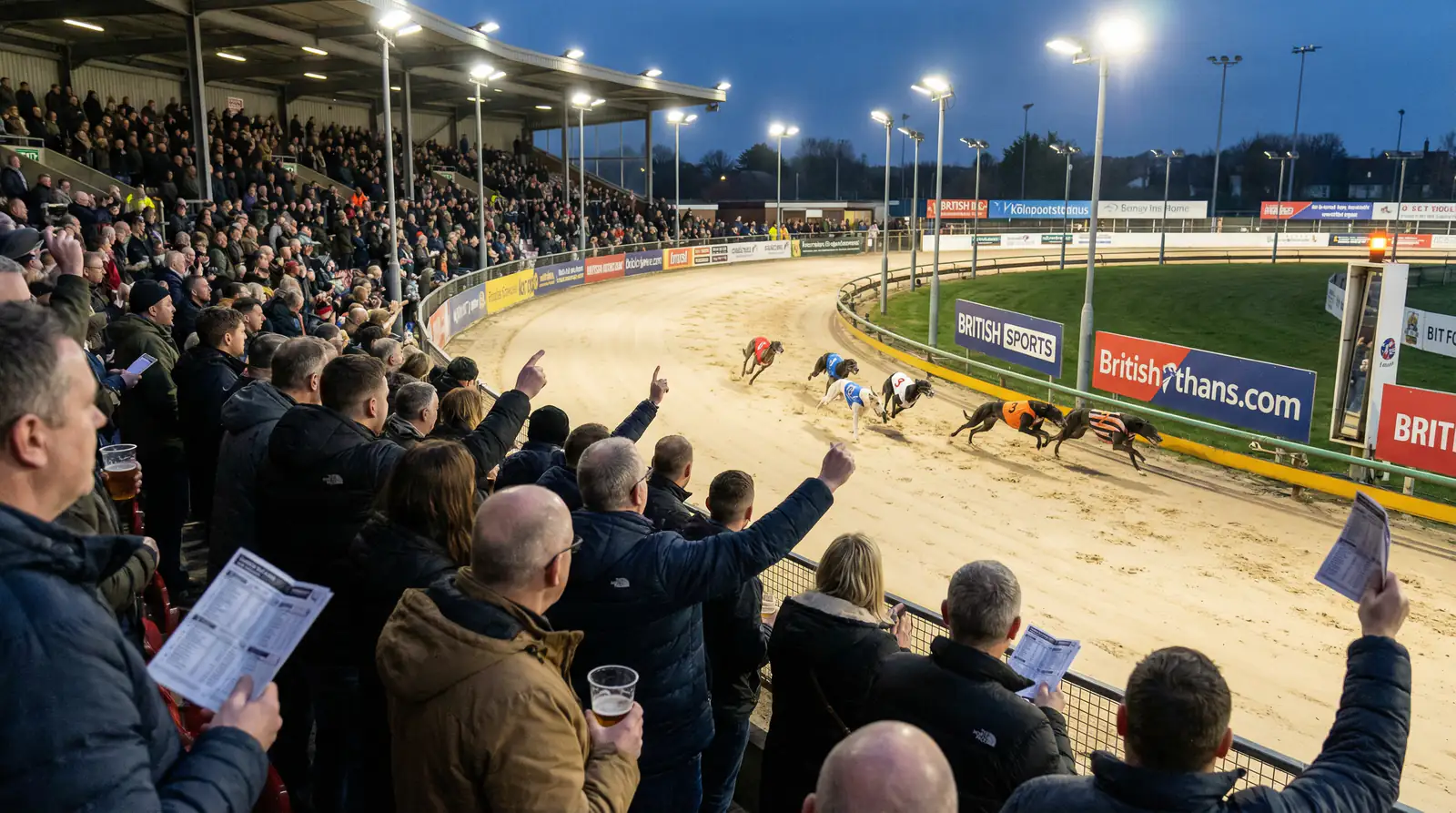
Best Greyhound Betting Sites – Bet on Greyhounds in 2026
Loading...
Monmore Evening Meetings: Schedule and Format
Thursday and Saturday evenings are Monmore’s shop window. While the track races four or more afternoons a week through the Bookmakers’ Afternoon Greyhound Service, the evening meetings are the ones the stadium actually promotes — the ones with restaurant bookings, trackside bars open on all three levels, and a crowd that can push toward the venue’s 1,150 capacity on special race nights.
Evening meetings at Monmore typically start around 18:00 to 18:30, with the first race going off shortly after and the card running through 12 races spaced roughly 15 to 18 minutes apart. The final race usually closes out the evening between 21:30 and 22:00. This structure has been consistent since Monmore’s deal with SIS formalised the Thursday and Saturday evening schedule, and it gives punters a predictable window for both live attendance and remote betting.
The format of an evening card at Monmore generally features a range of distances — 480 metres is the backbone, but expect to see 264-metre sprints, 630-metre middle-distance races, and occasionally longer trips over 684 or 835 metres mixed into the programme. Open races and graded events at higher levels (A1 through A4) appear more frequently on evening cards than on afternoon fixtures, which tend to concentrate in the middle-to-lower grades. Major competitions like the Ladbrokes Gold Cup, the Puppy Derby, and the Trafalgar Cup are staged exclusively on evening meetings, drawing higher-quality fields and larger on-course crowds.
For anyone planning a visit, Thursday evenings tend to be quieter than Saturdays, which means easier access to viewing positions and shorter queues at the tote windows. Saturday nights carry a social atmosphere that Thursday lacks — group bookings, birthday parties, corporate outings — but the racing quality is comparable across both evenings. From a betting perspective, the distinction between the two nights is minimal. The grading, distances, and dog quality are broadly similar. The difference is in the crowd, not the card.
How Evening Racing Differs from Afternoon BAGS
Higher grades, bigger occasions, different energy. That’s the short version. The longer version involves understanding why the same track can produce meaningfully different form data depending on whether the meeting runs under floodlights or afternoon sun.
BAGS races — Bookmakers’ Afternoon Greyhound Service fixtures — exist primarily to provide content for betting shops and online platforms during the day. They are functional rather than promotional. Admission is typically free, crowds are minimal, and the grading tends to cluster in the middle and lower tiers: A5 through A10, with occasional A4 races but rarely anything higher. The dogs racing on a Monday afternoon BAGS card at Monmore are not, as a rule, the same calibre as those on the Saturday night programme.
Evening meetings carry higher grades because the racing office schedules its strongest fields for the nights when attendance, television coverage, and betting turnover are highest. An A1 or A2 race at Monmore evening is a materially faster, more competitive contest than an A7 race on a Wednesday afternoon. The winning times reflect this. A good 480-metre time on a Saturday evening might be 28.80 or better. On a Monday afternoon in the lower grades, 29.40 would be competitive. These are different leagues, staged at the same venue.
This distinction has direct implications for form assessment. A dog that has been winning A6 races on Tuesday afternoons and then moves to an A4 race on Thursday evening is stepping up in class, even though it hasn’t changed tracks. Its afternoon form, impressive as it looked, was achieved against weaker opposition. Whether that form translates to the evening card depends on the dog’s raw speed, its ability to handle early pace pressure from better rivals, and how the racing office has graded the transition. Punters who treat all Monmore form equally, regardless of meeting type, are folding two distinct competitive contexts into one — and that’s where mistakes happen.
The going can also differ between afternoon and evening meetings. A track that raced on drying sand at 14:00 may have been harrowed and watered before the evening programme, resetting the surface conditions. Temperature drops in the evening can affect sand compaction. These are marginal factors, but in a sport where races are decided by lengths measured in tenths of a second, marginal factors accumulate.
Tracking Evening Results and Trends
Evening form is premium form. That statement needs qualification — it doesn’t mean afternoon form is worthless — but it reflects the reality that evening results are generated by stronger fields, in higher grades, under conditions more representative of peak competition at Monmore.
Tracking evening results specifically, rather than blending them with afternoon data, gives you a cleaner dataset for several types of analysis. Trap bias, for instance, can behave differently on evening cards because the dogs are faster and the first-bend congestion dynamics change when early pace is higher. A trap that performs adequately in A7 afternoon races might underperform in A2 evening contests because the inside dogs break faster and the crowding at the 103-metre mark is more intense.
Winning times on evening cards offer a more reliable benchmark for comparing dogs that have raced at similar grades. If two dogs both ran 29.00 over 480 metres, but one did it in an A2 evening race and the other in an A6 afternoon, the evening performance is almost certainly superior once you account for the opposition quality and the likelihood of interference. Adjusted ratings from Timeform attempt to factor this in, but even their calculations can’t fully capture the competitive gap between meeting types.
Trainer patterns are often more visible in evening data because the best kennels tend to concentrate their strongest dogs on evenings. A trainer who targets Saturday evenings with freshly rested dogs coming off trials is employing a deliberate preparation strategy. That pattern becomes clear only when you isolate evening results from the wider database and track which kennels appear — and win — disproportionately on specific nights.
The practical method is straightforward: maintain a separate record of evening results, even if it’s just a notebook entry after each Thursday and Saturday card. Note the winners, their traps, their times, and the grade. Over a few weeks, patterns emerge that are invisible in the aggregated data. A trap position that’s been winning every other Saturday. A trainer whose dogs peak in a two-week cycle. A distance that consistently produces unexpected results on evening going. These are the kinds of observations that informed punters monetise — and they start with treating evening results as their own category.
The Night Crowd and What It Means for Markets
More punters on track shifts the tote pools, and that shift has consequences for anyone betting into pari-mutuel markets. On a quiet Monday afternoon, the on-course tote pool for a single race at Monmore might be modest — a few hundred pounds at most. On a busy Saturday evening, particularly during a feature event, the pool deepens considerably. More money flowing into the pool means the tote returns stabilise, producing dividends that more closely reflect the true market view rather than being distorted by a handful of large wagers.
For bookmaker markets, the evening crowd has a different kind of influence. Higher betting volume on evening races means the bookmaker’s liabilities are larger, which in turn means the market tends to be more efficient. On afternoon BAGS races, where turnover is lower and market-making is thinner, you can occasionally find prices that feel soft — odds that don’t quite match the form. On Saturday evenings, the market is sharper. Favourites are priced more accurately, and value, while still present, requires more work to identify.
The social betting element of the evening crowd also introduces a layer of noise. Groups who have booked a table in the restaurant are often betting casually — picking names they like, backing the favourite because the favourite “must be favourite for a reason,” or spreading small stakes across every dog in a race for the entertainment of watching something come in. This recreational money inflates the tote pools without adding informational content. In theory, this means that informed bettors can extract slightly better value from tote pools on busy evenings than on quiet afternoons, because the recreational layer pushes up returns on less-fancied runners.
In practice, the edge is small but real. A dog that the form says should be second or third favourite, but which the evening crowd ignores in favour of the obvious market leader, might return a longer tote price than its fixed-odds SP suggests. It’s not a transformative advantage, but across a season of Saturday nights, it adds up. The night crowd doesn’t change the racing. It changes the maths around the racing. And for punters who understand where their returns come from, that distinction is worth a few extra pounds every week.