 Monmore dogs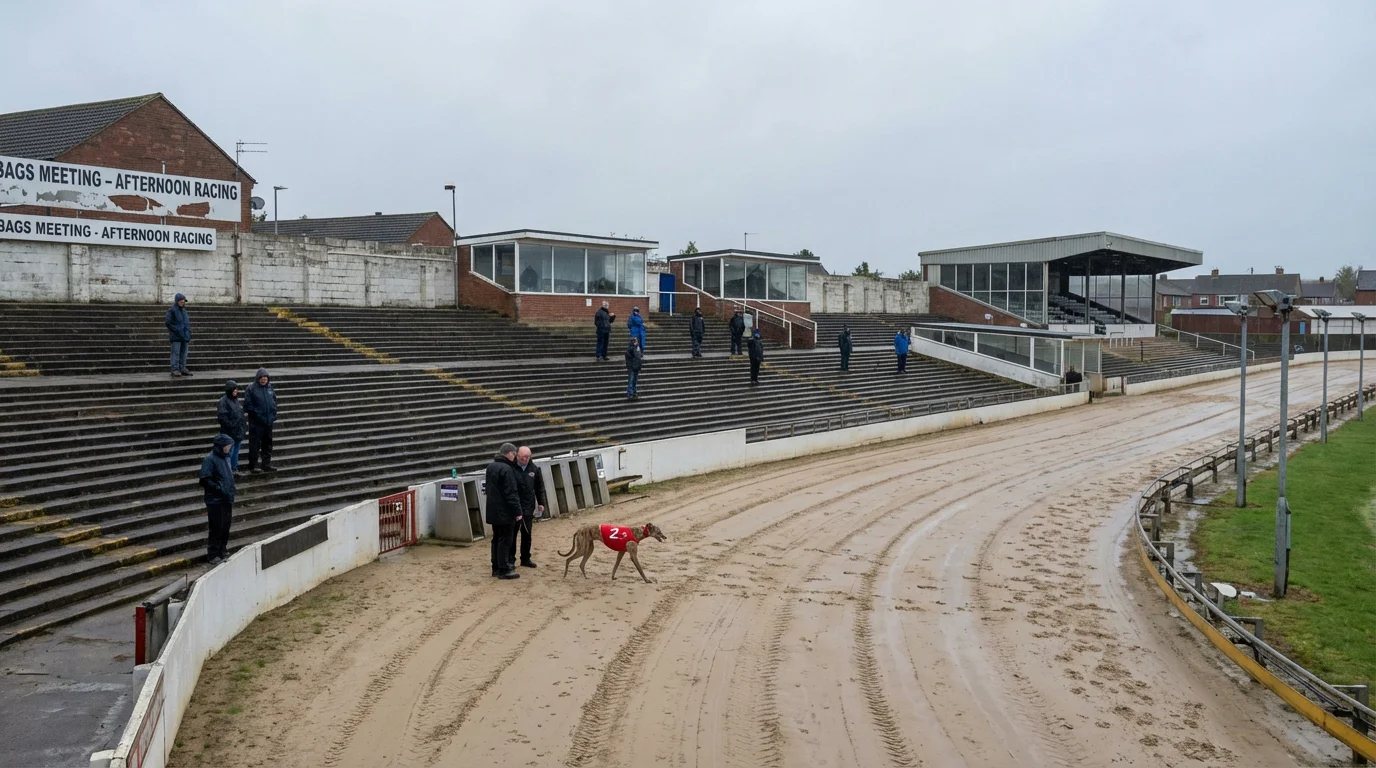
Best Greyhound Betting Sites – Bet on Greyhounds in 2026
Loading...
What Are BAGS Races at Monmore?
Bookmakers’ Afternoon Greyhound Service — built for the betting shop, not the stadium. BAGS is the framework that keeps greyhound racing content flowing to off-course bookmakers during daytime hours, providing a continuous stream of races for punters who want to bet on the dogs between morning and early evening. At Monmore Green, BAGS fixtures form the backbone of the weekday schedule, with afternoon meetings running most days while the stadium’s main public-facing events are reserved for Thursday and Saturday evenings.
The concept originated in 1967, when a consortium of leading bookmaking firms formed the Bookmakers’ Afternoon Greyhound Service to provide betting content during afternoons when horse racing was unavailable. The first tracks selected were Park Royal, Kings Heath, Stamford Bridge and Oxford. Monmore did not join the BAGS circuit until the winter of 1981, when a run of atrocious weather wiped out much of the British horse racing calendar. Greyhound racing, run on all-weather sand surfaces, was unaffected by the conditions that grounded the horses, and Monmore held BAGS fixtures for the first time — a genuine piece of the track’s heritage.
Today, BAGS races at Monmore are broadcast through Sports Information Services (SIS) to betting shops and online platforms nationwide. The races are real — same track, same dogs, same rules as any other licensed GBGB meeting — but the atmosphere is different. The stands are largely empty. Admission is free. The commentary is pitched for the broadcast audience, not the trackside viewer. And the grading tends toward the middle and lower tiers, with the strongest dogs held back for evening meetings where prize money, prestige, and public attention are higher.
For punters, BAGS races represent volume. Monmore alone contributes four afternoons of racing per week to the BAGS schedule, which means a steady supply of form data, betting opportunities, and results to track. Whether that volume translates into value depends entirely on how you approach it.
BAGS Race Days: Monday, Tuesday, Wednesday, Friday
Four afternoons of races that most fans never attend. That’s the reality of the BAGS schedule at Monmore, and it’s also what makes these meetings interesting for a specific type of bettor — the one who prefers quiet markets and consistent data over the noise of a packed Saturday night.
The standard BAGS timetable at Monmore sees afternoon meetings on Monday, Tuesday, Wednesday, and Friday, with the first race typically going off between 10:30 and 11:00 and the card running through 12 races into the early afternoon. The exact start time varies slightly by day and season, and the schedule can shift for bank holidays or special events, but the basic structure is stable enough to plan around.
Each afternoon card features a mix of distances, with 480 metres as the predominant trip. Sprint races over 264 metres and middle-distance events over 630 metres appear regularly, though staying trips over 835 metres or longer are less common on afternoon cards than on evening programmes. The grading typically ranges from A5 to A10, with occasional A4 races on Fridays when the racing office uses the afternoon meeting as a stepping stone toward the weekend evening programme.
From a scheduling perspective, Monmore’s BAGS days create a rhythm. A dog that raced on Monday might appear again on Friday, with enough recovery time to maintain performance. Some trainers use the Monday-Friday cycle deliberately, running a dog in a lower grade on Monday to sharpen it before a step up in class on the following week’s evening card. Others use BAGS meetings as a proving ground for younger dogs that aren’t yet ready for the intensity of open-grade evening racing.
The broadcast coverage through SIS means that results from every BAGS meeting are available in real time to anyone with access to a licensed bookmaker’s platform. Unlike evening meetings, where attending the track adds a dimension of information — watching the parade, reading the body language of dogs and trainers — BAGS races are consumed almost entirely through screens. The data is the same. The experience is different.
Do BAGS Results Carry Over to Evening Form?
The dogs are the same. The competition level may not be. That tension sits at the heart of how punters should interpret form generated at BAGS meetings when the same dogs appear on evening cards.
At its simplest, a dog that has been winning A7 races on Wednesday afternoons and is then entered in an A5 race on Thursday evening has stepped up in class. The winning form is real — the dog crossed the finish line first — but it was achieved against opposition that the racing office graded at a lower level. Whether that form holds when the opposition is faster, the early pace is stronger, and the first-bend congestion is more intense is the central question.
The answer, like most answers in greyhound form analysis, is conditional. Some dogs improve when raised in class. The faster pace suits their running style, or the higher-quality opposition spreads more evenly across the traps, reducing the first-bend trouble that is common in lower-grade fields where trap discipline is less reliable. Other dogs flatline or regress, because the margin that allowed them to win at A7 disappears when every rival is a second faster to the first bend.
Finishing times offer a partial bridge between the two contexts. A dog that ran 29.10 in an A7 BAGS race on Tuesday has posted a time that would be competitive in many A5 evening races, where the average winning time might be 29.00 to 29.20 depending on the going. But raw time comparisons are unreliable without adjusting for conditions. The going on a Tuesday afternoon and a Thursday evening can differ meaningfully even at the same track, because the sand surface is harrowed and potentially watered between meetings.
The most reliable cross-over indicator is run style rather than raw time. A dog that showed strong early pace on a BAGS card — leading from the first bend and controlling the race — is demonstrating a trait that transfers across grade levels. Early pace is less dependent on the quality of opposition and more dependent on the dog’s own trapping speed and acceleration. A dog that won BAGS races by coming from behind, on the other hand, may have relied on slower rivals fading rather than its own closing speed improving — and that kind of form is less portable.
The practical rule: treat BAGS form as relevant but discounted. Use it to assess a dog’s traits — speed, trapping, run style — rather than its finishing position. And always note the grade gap. A dog moving from A7 afternoon to A5 evening is making a two-grade jump in a higher-quality meeting type. That’s not a trivial step, and the form needs to be read through that filter.
BAGS Betting: What Punters Should Know
Lower-grade racing, tighter margins. That summary captures the essential character of betting on BAGS fixtures at Monmore, and it carries both a risk and an opportunity.
The risk is in the unpredictability. Lower-grade races at Monmore — A6 through A10 — feature dogs that are, by definition, less consistent than their higher-graded counterparts. These are dogs that might win by five lengths one week and finish last the next, not because they’ve lost form but because the race dynamics shifted. A bumped first bend, a slow break from the traps, a rival that ran an unexpectedly fast early section — in lower grades, these disruptions happen more frequently because the dogs are less experienced at navigating traffic and less able to recover from early trouble.
The opportunity is in the pricing. Because BAGS races attract less market attention than evening meetings, the odds are set by a thinner layer of informed money. Bookmakers still price every race, but the volume of sophisticated money flowing into a Tuesday afternoon A8 race at Monmore is a fraction of what shapes the Saturday evening A1 market. This means prices can be softer. Favourites are occasionally under-bet, and outsiders are occasionally over-bet, relative to their genuine chances. For punters who put in the form work, these inefficiencies create value.
Forecast and tricast bets on BAGS races can produce substantial returns precisely because the results are less predictable. When three outsiders fill the first three positions in a lower-grade afternoon race — which happens more often than in open-grade evening racing — the tricast dividend can reach three or four figures. That’s not a strategy in itself, but it’s a reason to consider exotic bets on BAGS cards more willingly than on evening meetings where the market is tighter and the results more predictable.
The staking discipline for BAGS betting should reflect the higher variance. Flat stakes — the same amount on every bet — are more appropriate for afternoon racing than progressive staking or aggressive bank-chasing. The variance in lower grades will test any bankroll management system, and the punter who survives a losing run on BAGS races is usually the one who kept their stakes level and their expectations calibrated to the grade of competition. Monmore’s afternoon racing offers genuine opportunity, but it demands a temperament suited to grinding out small edges over dozens of races rather than landing one big winner. That patience is the price of entry.