 Monmore dogs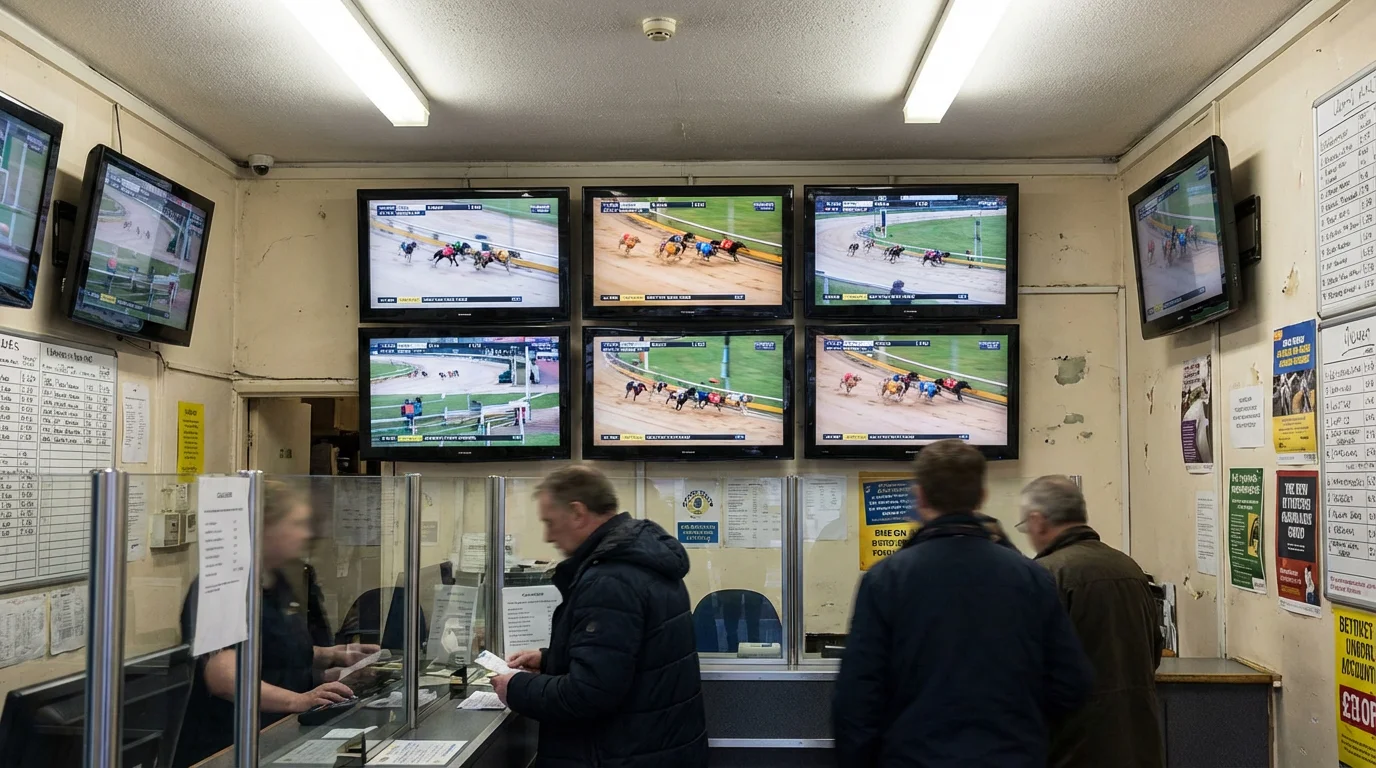
Best Greyhound Betting Sites – Bet on Greyhounds in 2026
Loading...
What Is a Greyhound Accumulator?
Chain selections together. One break and it’s over. An accumulator links individual bets across multiple races into a single wager, where the return from each winning selection rolls forward as the stake for the next. Every leg must win for the bet to pay out. One loser, at any point in the chain, and the entire accumulator fails.
The appeal is obvious: compounding returns across several races can produce payouts that dwarf what any single bet would deliver. Back four dogs at 3/1 each in a four-fold accumulator and, if all four win, a one-pound stake returns 256 pounds. The same pound staked as four individual win bets at 3/1 returns a total of 16 pounds. The multiplication effect is powerful, and it’s what makes accumulators the most popular bet type among recreational punters in UK greyhound racing.
The catch is probability. Four selections at 3/1 each imply roughly a 25% win probability per leg, assuming the odds are fair. The combined probability of all four winning is 25% raised to the fourth power — approximately 0.4%. You’d need to land this bet roughly once every 250 attempts to break even at 256/1 returns. The maths is seductive on the reward side and punishing on the probability side, which is why accumulators are frequently described by professional bettors as the bookmaker’s best friend.
None of this means accumulators are worthless. They have a legitimate role in a structured betting approach, provided the punter understands what they’re buying: a low-probability, high-return wager that will lose far more often than it wins. The question isn’t whether to use accumulators, but how to use them without letting the excitement of potential payouts override the discipline that every betting strategy requires.
Doubles, Trebles and Four-Folds Explained
Two legs is a double. Beyond four, it’s ambition. The terminology for accumulators is based on the number of selections, and each step up the ladder increases both the potential return and the difficulty of landing the bet.
A double links two selections. Both must win for the bet to pay out. The return from the first winner becomes the stake on the second. If both dogs are at 3/1, the return is 15 pounds to a one-pound stake — the first leg returns 4 pounds, which is staked on the second leg at 3/1, returning 16 pounds minus the original stake. Doubles are the most manageable form of accumulator because the probability hit is relatively modest. Two independent events at 25% each combine to roughly 6.25% — tough but not unrealistic.
A treble adds a third leg. Three winners required, three lots of compounding. The same 3/1 scenario produces a return of 64 pounds per pound staked. The probability drops to around 1.5%. Trebles sit at the boundary between plausible and optimistic — experienced Monmore punters will land trebles periodically across a season, but the losing streaks between successful ones can be lengthy.
A four-fold is where the maths starts to tilt firmly against you. Four independent events at 25% combine to a probability below half a percent. The headline returns are eye-catching, but you’d need to land the bet roughly once in every 250 attempts to break even. Five-folds and six-folds exist, and bookmakers are happy to accept them, but the probability of landing a six-fold accumulator on greyhound racing is so low that it belongs more in the realm of entertainment than strategy.
There’s also the Lucky 15, Lucky 31, and other full-cover bet formats that package singles, doubles, trebles, and accumulators into a single wager. A Lucky 15, for example, covers four selections in every possible combination: four singles, six doubles, four trebles, and one four-fold — fifteen bets in total. The advantage is that you collect even if only one selection wins. The disadvantage is that you’re placing fifteen bets, so the total stake is fifteen times the unit. These formats reduce the all-or-nothing nature of a straight accumulator but at a proportional cost.
Calculating Potential Returns
Each leg multiplies the previous payout. That’s the core arithmetic of accumulator returns, and while the calculation is simple in principle, the real-world maths deserves careful attention before you commit your stake.
The formula is straightforward: multiply the decimal odds of each selection together, then multiply by your stake. If you back three dogs at decimal odds of 4.00, 3.50, and 5.00, the combined decimal return is 4.00 multiplied by 3.50, multiplied by 5.00, which gives 70.00. A one-pound stake returns 70 pounds. In fractional terms, that’s three dogs at 3/1, 5/2, and 4/1 — the maths is the same, just expressed differently.
What the headline return obscures is the implied probability. Those three decimal odds — 4.00, 3.50, 5.00 — imply individual win probabilities of 25%, 28.6%, and 20% respectively, if the odds are fair. The combined probability of all three winning is approximately 1.4%. You’d need to land this treble roughly once every 70 attempts to break even. If the bookmaker’s margin inflates the odds slightly against you — which it always does — you need an even higher strike rate or a better selection of overpriced dogs to show a profit.
Most bookmaker websites and betting apps include an accumulator calculator that shows the potential return before you place the bet. Use it, but don’t let the number seduce you. A potential return of 500 pounds on a five-fold sounds thrilling until you calculate that the probability of it landing is a fraction of one percent. The potential return is real but hypothetical. The stake is real and immediate.
One figure worth calculating before any accumulator is the break-even point: how often does this bet need to win for you to show a long-term profit? Divide 1 by the decimal return to get the minimum required win rate. For a treble returning 70.00, you need it to win more than 1 in 70 times — roughly 1.4%. If your honest assessment of the three selections suggests a combined probability above that threshold, the accumulator has a positive expectation. If it doesn’t, you’re paying for excitement rather than value.
Accumulator Discipline: Protecting Your Bankroll
The best accas are small stakes, not big ones. That principle applies universally, but it’s especially important at Monmore where the temptation to build accumulators from a busy card — twelve races on an evening programme, each one a potential leg — can lead punters into reckless staking territory.
The first rule is stake sizing. Accumulators should represent a small fraction of your bankroll — one or two percent at most. The losing rate on accumulators is so high that over-staking will deplete your funds before the occasional big return has a chance to compensate. A one-pound accumulator that loses is a shrug. A twenty-pound accumulator that loses stings, and three of them in an evening can damage a recreational bankroll significantly.
The second rule is leg selection. Don’t build accumulators from twelve races just because the card has twelve races. The fewer legs in the accumulator, the higher the strike rate. A well-chosen double on two races where you have strong conviction is a better long-term bet than a six-fold built from races you’ve barely analysed. The temptation to add more legs is always present — each addition makes the potential return look more exciting — but every extra leg multiplies the probability of failure alongside the payout.
The third rule is independence. Each leg of the accumulator should represent a genuine selection based on form analysis, not a filler chosen to pad the return. If you’ve identified two strong bets on a Monmore evening card, a double on those two is the disciplined approach. Adding a third leg from a race you’re unsure about — because three legs looks better than two — turns a sound wager into a gamble. The weakest leg in any accumulator is the one most likely to kill it.
Finally, consider your motives. If you’re placing accumulators for entertainment — the thrill of watching each leg land, the mounting excitement as the final race approaches — that’s a legitimate use of your leisure budget, provided the stakes are genuinely small and you’re comfortable losing them. If you’re placing accumulators as a strategy to grow your bankroll, the maths is working against you in almost all circumstances. Professional greyhound bettors rarely use accumulators. They bet in singles, because singles allow them to isolate the value in each race without compounding the risk of independent events into a chain that one bad break can destroy.