 Monmore dogs
 Monmore Green Stadium History and Major Races Guide
 Available in US
From its 1928 opening to the Ladbrokes Gold Cup, explore Monmore Green Stadium's history, major races, record holders and the venue's transformation.
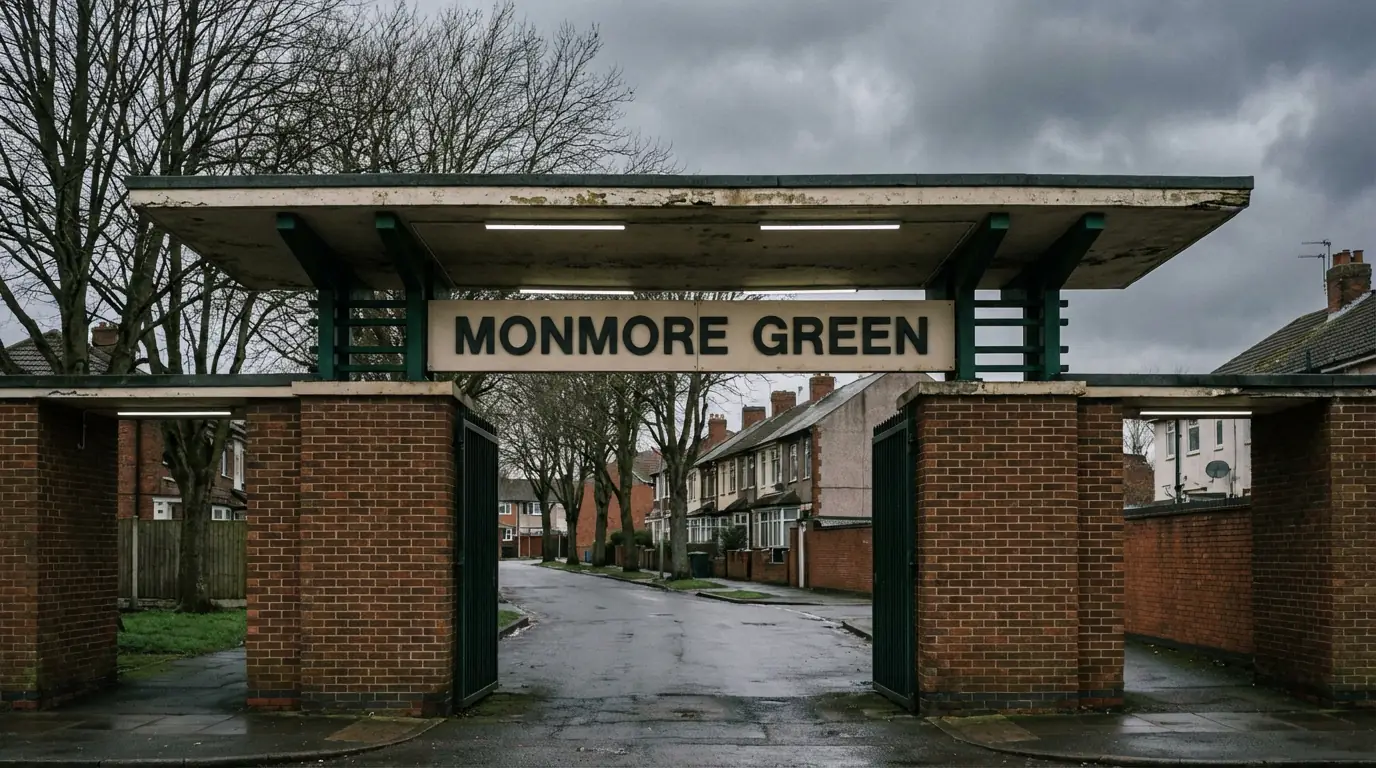
1928: Opening Night at Monmore Green
Ten thousand people came to Sutherland Avenue on a Wednesday in January. The date was 11 January 1928. The venue was a newly constructed greyhound stadium on a patch of undeveloped land between the Great Western Railway line and East Park, in the Monmore Green district south-east of Wolverhampton city centre. The organiser was a company called the Midland Greyhound Racing Association, and the evening they put on consisted of seven races — including two hurdle events — watched by a crowd whose size suggested that greyhound racing, then barely two years old as a commercial sport in Britain, had already captured the West Midlands.
The first greyhound to win a race at Monmore Green was Arrow Tranby, which took the Shirley Stakes over 500 yards at odds of 6/1, recording a time of 32.08 seconds. The track ran under rules similar to those of the National Greyhound Racing Club, which had been established the same year. Racing was held under floodlights — itself a novelty in 1928, and one that drew as many curious onlookers as dedicated punters. The combination of evening entertainment, electric illumination, and affordable admission made greyhound racing accessible in a way that horse racing, with its afternoon meetings and distant courses, was not. Monmore was built for the working population of Wolverhampton, and on opening night, the working population turned up.
The stadium that opened in 1928 bore only a passing resemblance to the venue that stands today. The original track was measured in yards, not metres: 300, 525, and 700 yards were the standard distances, contested by fields of five dogs rather than six, with an outside Sumner hare. The infrastructure was basic — functional seating, a perimeter fence, and the electric hare mechanism that made the whole enterprise possible. What the stadium lacked in refinement, it compensated for in atmosphere. Greyhound racing in the late 1920s was a phenomenon, not a tradition. It was new, it was fast, and it arrived in Wolverhampton with a crowd of ten thousand to prove it.
The Midland Years: 1930s to 1960s
By 1932, the Midland Greyhound Racing Association had been succeeded by the Midland Greyhound Company, which purchased the stadium and began consolidating its position in the regional racing circuit. In 1935, the company acquired a sister track at Willenhall, four miles away, and the large resident kennels at Monmore were split in two to service both venues. This arrangement — shared kennel resources, joint racing managers, coordinated fixture lists — defined Monmore’s operational structure for the next three decades.
The Second World War closed most greyhound tracks in Britain. Monmore was one of the exceptions. While Willenhall suspended meetings, Monmore continued racing through the war years, albeit with reduced programmes held during daylight hours under wartime regulations. Early wartime races featured fields of five dogs, typically with trap three left vacant, over distances of 300, 525, and 700 yards. The decision to stay open was not trivial: maintaining a racing operation during rationing, labour shortages, and blackout regulations required a commitment from both the management and the local community that continued to attend.
The war years also produced one of Monmore’s most enduring competitions. In 1943, the track introduced the Midland Puppy Championship, a race for juvenile greyhounds that would later be renamed the Midland Puppy Derby and eventually the Ladbrokes Puppy Derby. It remains on the Monmore calendar to this day, making it one of the longest continuously running competitions at the stadium. Other events introduced during this period included the Midland St Leger, the Midland Classic Potential, the Pride of the Midlands, and the Staffordshire Knot — names that reflected both the regional identity of the track and its ambition to establish a racing programme with depth beyond the weekly graded card.
The post-war decades were a period of steady operation rather than dramatic expansion. Racing management was shared between Monmore and Willenhall, with Peter Cartwright and later Bob Harwood serving as joint racing managers. The track ran regular Thursday and Saturday evening meetings supplemented by midweek cards, building the fixture pattern that would eventually become the six-day-a-week schedule of the modern era. The stadium was functional but ageing, and by the early 1960s, it was an infrastructure investment away from either renewal or decline.
The 1963 Fire and Rebuilding
The grandstand went up, and the track went dark. In 1963, a devastating fire swept through the main grandstand at Monmore Green, destroying the structure and forcing the stadium to close for a considerable period while repairs and safety work were completed. The annual Midland Puppy Championship was temporarily moved to Willenhall. The damage was extensive, and the closure was the most serious interruption to racing at Monmore since the venue had opened thirty-five years earlier.
What could have been the end of the stadium became its turning point. The fire provided both the necessity and the insurance impetus for a major rebuilding programme. The new grandstand, completed in the mid-1960s, was a significant upgrade on the structure it replaced: a glass-fronted restaurant with tiered viewing and waitress service, multiple levels of spectator access, and modern facilities that brought the venue up to contemporary standards. The investment transformed Monmore from an ageing pre-war stadium into a modern racing venue, and the quality of the rebuild attracted interest from outside the region.
That interest came from Totalisators and Greyhound Holdings, known as TGH, a company building a portfolio of UK greyhound tracks. In 1970, TGH purchased both Monmore and Willenhall from the Midland Greyhound Company, adding them to a stable that already included Crayford, Gosforth, Leeds, and Brough Park. The fire, paradoxically, had made Monmore more attractive to corporate buyers by forcing the capital investment that the previous owners might never have made voluntarily.
Ladbrokes Era: Ownership and Modernisation
When Ladbrokes bought TGH in 1974, they inherited a track with unfinished potential. The post-fire rebuild had given Monmore modern infrastructure, but the track’s racing programme and commercial model were still rooted in the traditional evening-meeting format that had served British greyhound racing since the 1920s. Ladbrokes brought corporate resources, a national brand, and — eventually — a new commercial framework that would change when and why Monmore raced.
The most significant early development under Ladbrokes ownership was organisational rather than structural. Arthur Aldridge became Racing Director, and the management of Monmore was professionalised within a corporate portfolio that included Perry Barr in Birmingham and other venues across the country. The track’s resident kennels were demolished in the late 1980s, ending the era of on-site dog accommodation and replacing it with the contract trainer system that operates today. Under this model, licensed trainers keep their dogs at private kennels and transport them to the track for racing, giving both trainers and the stadium more operational flexibility.
Monmore’s profile within the wider greyhound calendar grew during this period. In 1986, the track hosted the Golden Jacket, a prestigious open race that had lost its home following the closure of Harringay Stadium and a brief spell at Hall Green. The Golden Jacket eventually settled at Crayford, but its temporary residence at Monmore signalled that the venue was capable of staging high-level competition. In 1994, the Midland Gold Cup — a pre-war event that had been discontinued — was relaunched at Monmore and became one of the track’s flagship competitions. It is now known as the Ladbrokes Gold Cup.
The 2010s brought further recognition. In 2011, Monmore won the BAGS National Track Championship, and Monmore-based trainer Chris Allsopp was crowned champion trainer in the same year. In 2018, the stadium signed a deal with SIS to stage racing six days a week — Monday through Saturday — cementing its position as one of the highest-volume venues in the country. Leading trainer Kevin Hutton joined the track in August 2018, further strengthening the kennel base. In 2022, Entain signed a long-term deal with Arena Racing Company for media rights, beginning in January 2024, ensuring that Monmore’s fixtures would continue to be broadcast nationally through licensed bookmaker channels.
BAGS: The Birth of Afternoon Dog Racing
Bad weather killed the horse racing calendar. Greyhounds filled the gap. In 1981, a severe spell of winter weather forced the cancellation of horse racing fixtures across the country, leaving betting shops without product to show and bookmakers without turnover to sustain them. The Bookmakers’ Afternoon Greyhound Service — BAGS — was created as a direct response: greyhound meetings staged during afternoon hours, timed to provide a betting-shop product while horse racing was unavailable.
Monmore held its first BAGS fixtures in 1981, and the format proved commercially viable enough to outlast the weather that had created it. BAGS meetings became a permanent feature of the racing calendar, running on weekday afternoons to a schedule designed around betting-shop broadcast windows rather than trackside attendance. The races are lower-profile than evening cards — the grades are generally lower, the crowd at the stadium is minimal, and the atmosphere is functional rather than festive — but they generate the majority of betting turnover at Monmore and provide the racing volume that sustains the track’s six-day-a-week operation.
For punters, BAGS meetings are significant because they produce a large body of form data. A dog racing on Monday afternoon, Tuesday afternoon, and again on Friday afternoon accumulates three data points in a single week — more than enough to track short-term trends in form, weight, and sectional times. The grading at BAGS meetings is typically less competitive than at evening cards, which means that form figures should be read in context: a first-place finish on a Monday afternoon BAGS card does not carry the same weight as a win on a Saturday evening open-race programme.
Major Races at Monmore Green
Five flagship events anchor the Monmore calendar, each sponsored by Ladbrokes and each carrying prize money that places them among the more valuable competitions outside the sport’s national championship events. These races draw entries from beyond the Monmore circuit, bringing dogs from other tracks and testing them against the particular demands of this venue — the sand surface, the 103-metre run to the first bend, and the specific bend geometry that rewards certain running styles over others.
Major races at Monmore serve a dual purpose. They are sporting events in their own right, with their own histories and roll calls of winners. They are also the meetings where the track’s data is most interesting to the analytical punter, because the open-class fields bring together dogs of known quality from across the UK circuit, producing races that test the track’s physical characteristics against the broadest possible range of ability. A trap bias that is marginal in a routine A5 graded race may become decisive when the margins between runners are narrower and the pace is faster.
The flagship events span multiple distances — from the 480-metre Gold Cup to the 630-metre Festival 630s — which means Monmore’s major race programme tests dogs across the track’s distance range, not just at the standard trip. This variety makes the annual competition calendar a useful reference point for assessing how different types of runner — sprinters, standard-distance dogs, stayers — perform on the Monmore surface relative to their form elsewhere.
The Ladbrokes Gold Cup
480 metres, open class, four-figure prize. The Ladbrokes Gold Cup is Monmore’s premier competition, run over the standard distance and open to greyhounds from across the UK. First staged in 1994 as the Midland Gold Cup — reviving a pre-war event of the same name — it has grown into one of the most respected 480-metre competitions outside the English Greyhound Derby. The winner’s prize of ten thousand pounds is significant by greyhound racing standards, and the roll of winners includes dogs of genuine class: Toms The Best, the 1998 English Greyhound Derby champion, and Taylors Sky, who won the Derby in 2011, are among the names on the Gold Cup honour board.
The Gold Cup has never been won in a time slower than thirty seconds, which gives an indication of the quality required. At Monmore, where 480-metre times in routine graded races sit in the 29.5 to 30.5 range depending on grade and going, a sub-30 performance is the territory of the track’s best dogs. The Gold Cup consistently produces racing at or near that level, making it a useful benchmark for evaluating how quickly the Monmore surface can run under optimal conditions.
The Ladbrokes Puppy Derby
Not to be confused with the national Puppy Derby — which was historically held at Wimbledon and later at Towcester — the Ladbrokes Puppy Derby at Monmore is a competition for juvenile greyhounds aged between fifteen and twenty-four months. It traces its lineage back to the wartime Midland Puppy Championship and is the oldest continuously running competition at the stadium, having operated under several names as sponsorship arrangements evolved.
The Puppy Derby matters because it is a window into the next generation of Monmore runners. Juvenile greyhounds are still developing physically and temperamentally, which makes the race a test of potential as much as current form. Dogs that perform well in the Puppy Derby often progress to higher grades and open-class competition at the track, and the event has historically served as an early indicator of which kennels are producing their most promising young runners. In 2022, the winner’s prize reached twenty thousand pounds — a figure that exceeded the long-established national Puppy Derby — signalling the event’s growing status within the UK greyhound calendar.
Trafalgar Cup and Other Events
First held at Wembley Stadium in 1929, the Trafalgar Cup is the oldest puppy competition in the greyhound racing calendar. It moved to Oxford Stadium in 1999 before arriving at Monmore Green in 2015, where it has quickly established itself as a valued event on the national puppy circuit. Run over 480 metres, it targets juvenile greyhounds and has attracted entries from leading kennels across the country since its move to Monmore. The prize fund and prestige have grown in each successive year, and the Trafalgar Cup is now considered one of the more important puppy competitions outside the traditional national championships.
Beyond the Gold Cup, Puppy Derby, and Trafalgar Cup, Monmore’s annual programme includes the Ladbrokes Festival 630s — a middle-distance event run over 630 metres — and the Ladbrokes Summer Stayers, which tests dogs over the longer staying trips. These events fill out the racing calendar across the distance range, ensuring that Monmore’s major race programme is not limited to a single trip. The Festival 630s, in particular, has carved out a reputation as a test of versatility: dogs that enter from the 480-metre ranks must prove they can sustain their speed over an extra 150 metres, while natural stayers must show they have the pace to compete against standard-distance dogs stepping up.
Track Records: The Fastest Dogs at Monmore
Records do not lie, but they do not tell the full story either. A track record is the fastest time recorded over a specific distance at a specific venue, and at Monmore, records exist for every standard racing distance from 264 metres to 835 metres. These times represent the absolute ceiling of performance at the track — the fastest a greyhound has ever run on this sand, around these bends, over this measured distance. They are benchmarks, not targets: most dogs will never approach them, and those that do are operating at the extreme upper end of the ability spectrum.
Track records at Monmore are shaped by several factors beyond the individual dog’s speed. Surface conditions on the night matter enormously — a record set on fast, dry sand in midsummer may be untouchable on a heavy winter surface. The going allowance, if applied, can convert a record-setting raw time into an adjusted time that, while still exceptional, looks less otherworldly. Competition matters too: a dog running unchallenged in front with a clear run to the line will post a faster time than one battling through traffic, regardless of raw ability. The circumstances of a record are as informative as the number itself.
For punters, track records serve two practical purposes. First, they provide an upper bound for time-based assessment. If a dog has clocked 29.20 over 480 metres and the track record is 28.80, you know the dog is running within half a second of the fastest time ever recorded — a genuinely strong performer. If it is running 30.50, you know there is a full second and a half between its level and the peak, which places it in a different class entirely. Track records anchor the time scale and prevent you from misjudging what constitutes a fast or slow performance at this specific venue.
Second, track records reveal the character of the track across distances. If the 264-metre record is proportionally closer to the 480-metre record than the distance ratio would suggest, it tells you that the sprint trip at Monmore is particularly suited to fast dogs — probably because the 103-metre run and the tight two-bend configuration favour pure speed. If the 835-metre record is proportionally slower than the 480-metre benchmark, it may indicate that the longer trip involves more bend negotiation and positional racing that slows the overall pace. The records, read as a set rather than individually, map the track’s physical characteristics onto the performance data.
Records change, and at an active track like Monmore, they change when a dog of exceptional ability meets optimal conditions. When a record falls, it is worth noting the circumstances: what was the going? What was the trap draw? Was it a solo front-running effort or a hard-fought race? These details tell you whether the record was a product of the dog, the night, or the combination — and whether it is likely to stand for years or fall again the next time the surface runs fast.
From Sutherland Avenue to the Future
Almost a century of racing. The traps still open. Monmore Green has survived fire, wartime, ownership changes, the collapse of the post-war greyhound boom, the closure of dozens of rival tracks across the country, and the transformation of the sport from a mass-attendance spectacle into a broadcast-driven betting product. It has done so not through glamour or historical prestige — Monmore has never been the Derby venue, never the most famous track in the country — but through adaptation and sheer operational persistence.
The track that opened in 1928 with five-dog races over 500 yards now stages six-dog races over metric distances, six days a week, broadcast to betting shops and online platforms through a deal that ensures Monmore’s fixtures reach a national audience. The resident kennels are gone, replaced by contract trainers who bring their dogs to the track from private facilities. The glass-fronted restaurant that was built from the ashes of the 1963 fire still overlooks the finishing line. Speedway, which shared the Monmore site from the late 1920s until 2023, has departed, leaving greyhound racing as the sole tenant of Sutherland Avenue.
The future of British greyhound racing is a subject that generates more debate than consensus. Track closures across the UK have reduced the number of licensed venues, and the sport’s economic model depends increasingly on broadcast income and betting turnover rather than gate revenue. Monmore, with its Entain ownership, its SIS broadcast deal, and its six-day fixture list, is better positioned than most to navigate that landscape. It is not immune to the pressures facing the wider sport, but its volume, its infrastructure, and its commercial partnerships provide a foundation that many closed or struggling venues did not have.
For now, the sand is harrowed, the traps are loaded, and the Swaffham hare runs its rail around a 419-metre oval in the same Wolverhampton district where ten thousand people came to see something new on a January evening nearly a hundred years ago. The scale has changed. The spectacle has not.
Explore Monmore Green stadium history on the monmoredogsresults homepage.
Read about the Ladbrokes Gold Cup in gold cup.
