 Monmore dogs
 Greyhound Weight and Its Effect on Racing Performance
 Available in US
How greyhound weight affects racing performance at Monmore. Typical weight ranges, weight trends, the weigh-in process and when weight data should influence your betting.
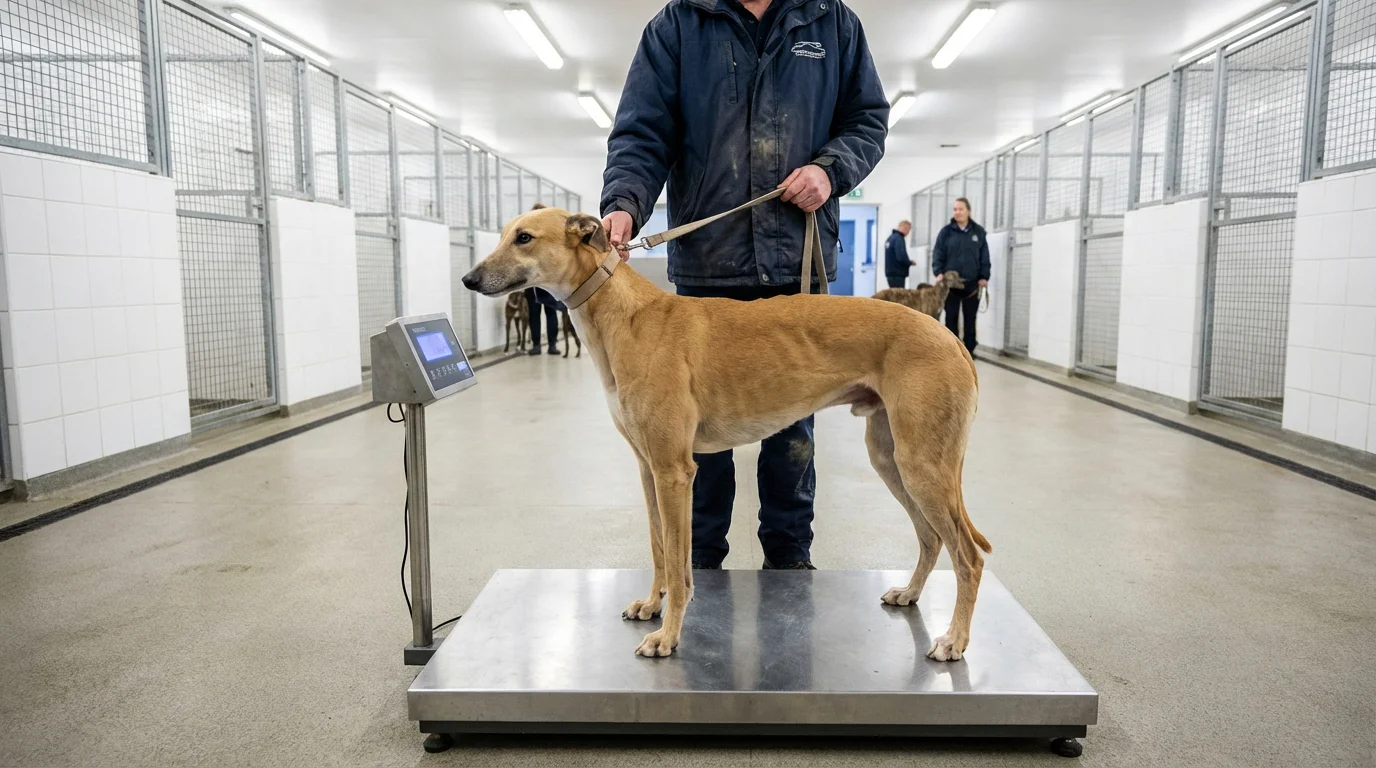
How Much Do Racing Greyhounds Weigh?
The typical range is 26 to 36 kilograms. Within that band, there is significant variation between individual dogs, and the weight tells you something — though not everything — about the type of runner you’re looking at.
Lighter greyhounds, those at the lower end of the scale around 26 to 29 kilograms, tend to be smaller-framed dogs. They often show good agility on the bends, which can be an advantage at a track like Monmore where the 419-metre circumference produces relatively tight turns. Lighter dogs can also be quicker out of the traps, since less body mass means less inertia to overcome in the initial acceleration. The trade-off is that lighter dogs may lack the raw power of their heavier rivals over the longer straights, and they can be more susceptible to being bumped off their line at the first bend when racing against bigger, stronger competitors.
Heavier greyhounds, in the 33 to 36 kilogram range, are typically more powerful animals. They generate more force with each stride, which can translate to higher top-end speed on the straights. Over sprint distances like Monmore’s 264 metres, where the race is predominantly a test of acceleration and raw pace, heavier dogs with good muscle tone often perform well. Over staying distances, the extra weight can become a disadvantage if it isn’t matched by proportionate stamina.
The relationship between weight and performance is not linear or simple. A 30-kilogram dog is not automatically faster or slower than a 34-kilogram dog. What matters more is the dog’s weight relative to its own frame — whether it’s carrying the right amount of condition for its build — and how that weight has changed over recent runs. A dog at its optimal racing weight, whatever that number is, will perform better than one that is over-conditioned or underweight.
Weight Trends: What Increases and Decreases Mean
A dog gaining weight steadily may be maturing, recovering from a race layoff, or simply being over-fed. A dog losing weight steadily may be reaching peak fitness, training harder than usual, or dealing with an underlying issue. The direction of the trend and the context around it are what give weight data its meaning.
Young greyhounds — dogs in their first year of racing — often show a natural upward weight trend as their bodies mature. A dog that raced at 29 kilograms six months ago and now weighs 31 kilograms hasn’t necessarily gained excess condition; it may have filled out into its adult frame. These increases are normal and typically correlate with improved performance as the dog reaches physical maturity, usually around two to three years of age.
For established racers, weight fluctuations between runs are more informative. A change of half a kilogram between consecutive races is common and usually insignificant — it can reflect nothing more than the timing of the dog’s last meal or its hydration level. A change of a full kilogram or more is worth noting. A dog that has gained a kilogram over two or three runs might be carrying extra condition that slows it over the final stages of a race. A dog that has lost a kilogram over the same period might be sharpening up — the kind of weight drop that experienced trainers deliberately manage in the weeks before a targeted race.
The most useful weight signal is a dog returning to its known optimal racing weight after a period away from that figure. If a dog’s best performances were recorded at 31.5 kilograms, and its recent runs at 33.0 have been disappointing, a weigh-in showing 31.8 suggests the trainer has been working to bring the dog back to peak condition. That kind of trend — a return toward a proven racing weight — is a stronger indicator than the absolute number itself.
Trainers manage weight deliberately. Diet, exercise intensity, trial frequency, and rest periods all influence how a dog’s weight tracks between races. A good trainer knows the optimal racing weight for each dog in their kennel and manages the preparation cycle to hit that weight on race day. The weigh-in figure on the racecard is the output of that management process — a data point that reflects the trainer’s preparation as much as the dog’s biology.
Weigh-In Process at Monmore
Dogs are weighed before every race at a GBGB-licensed track. The weigh-in is a standard part of the pre-race procedure at Monmore, conducted under the supervision of the stipendiary steward and recorded as part of the official race data.
The process is straightforward. Each dog is weighed on calibrated scales in the kennelling area before the meeting. The recorded weight, in kilograms to one decimal place, is added to the official racecard and included in the published results after the race. This means the weight is available to punters both before the race — on the racecard — and after it — in the form data for future reference.
The weigh-in serves both a welfare and an integrity function. From a welfare perspective, it provides an official record of each dog’s physical condition that can be monitored over time. A dog whose weight drops dramatically between races might be flagged for veterinary examination. From an integrity standpoint, the weigh-in is part of the data trail that ensures consistency and transparency in the racing process — the weight at which a dog raced on a given night is a matter of record.
Some punters check the racecard weights before making their selections, comparing each dog’s current weight against its recent racing weights. This is a legitimate form analysis practice, though it requires context. A weight that looks unusual in isolation — notably higher or lower than the dog’s recent average — might be meaningful, or it might be within the normal range for that individual. Without tracking the dog’s weight history over several runs, a single weigh-in figure tells you very little. It’s the trend, not the snapshot, that carries the information.
Should Weight Influence Your Betting?
Weight is a secondary factor, not a primary one. It should never be the sole reason for backing or opposing a dog, and it should never override strong form evidence in either direction. But as a supplementary data point — one piece of context among several — weight has a place in a thorough form analysis.
The situations where weight most usefully informs a betting decision are when it confirms or contradicts other signals. If a dog has shown improving form over its last three runs, and its weight has been trending toward its optimal racing figure over the same period, those two trends reinforce each other. The form says the dog is in good shape. The weight says the trainer has been preparing it carefully. Together, they build a stronger case than either signal alone.
Conversely, if a dog’s form looks solid but its weight has increased by a kilogram and a half over three races, that discrepancy is worth questioning. The form might sustain itself — some dogs perform perfectly well at varying weights — but the weight increase introduces a doubt. Maybe the dog is carrying extra condition that hasn’t affected its results yet but might in a tighter race. Maybe the trainer has allowed the weight to creep up between campaigns. Either way, the weight data adds a caution that the form figures alone don’t provide.
The error to avoid is over-weighting weight. It is one variable among many: form, trap draw, distance, grade, going, trainer, running style. Punters who build complex theories about optimal weight ranges and performance thresholds are usually extracting more signal from the data than it actually contains. The noise in weight figures — meal timing, hydration, scale calibration — is significant enough that small fluctuations should be treated as noise rather than information.
The practical rule is simple: check the weight, note the trend over recent runs, flag anything that deviates significantly from the dog’s established range, and then put the data in its proper place — as supporting evidence, not as the foundation of your selection. Form comes first. Trap draw comes second. Weight comes somewhere after that, in the category of details that occasionally matter and are worth checking for the times when they do.
Learn how greyhound weight affects racing on the monmoredogsresults homepage.
Combine weight data with form analysis in form analysis.
