 Monmore dogs
 UK Greyhound Tracks Compared: Monmore vs Other Venues
 Available in US
Compare Monmore Green with other UK greyhound tracks. Track sizes, bend geometry, surface differences, grading levels and why track-specific form data matters for betting.
How Monmore Compares to Other UK Tracks
Not all 480-metre tracks race the same way. A dog that wins comfortably at Monmore might struggle at Romford or sail home at Nottingham, and the reasons are structural rather than mysterious. Each UK greyhound stadium has its own geometry — a specific circumference, a particular distance from traps to first bend, a surface with its own characteristics — and those physical properties shape how races unfold in ways that form figures alone don’t always capture.
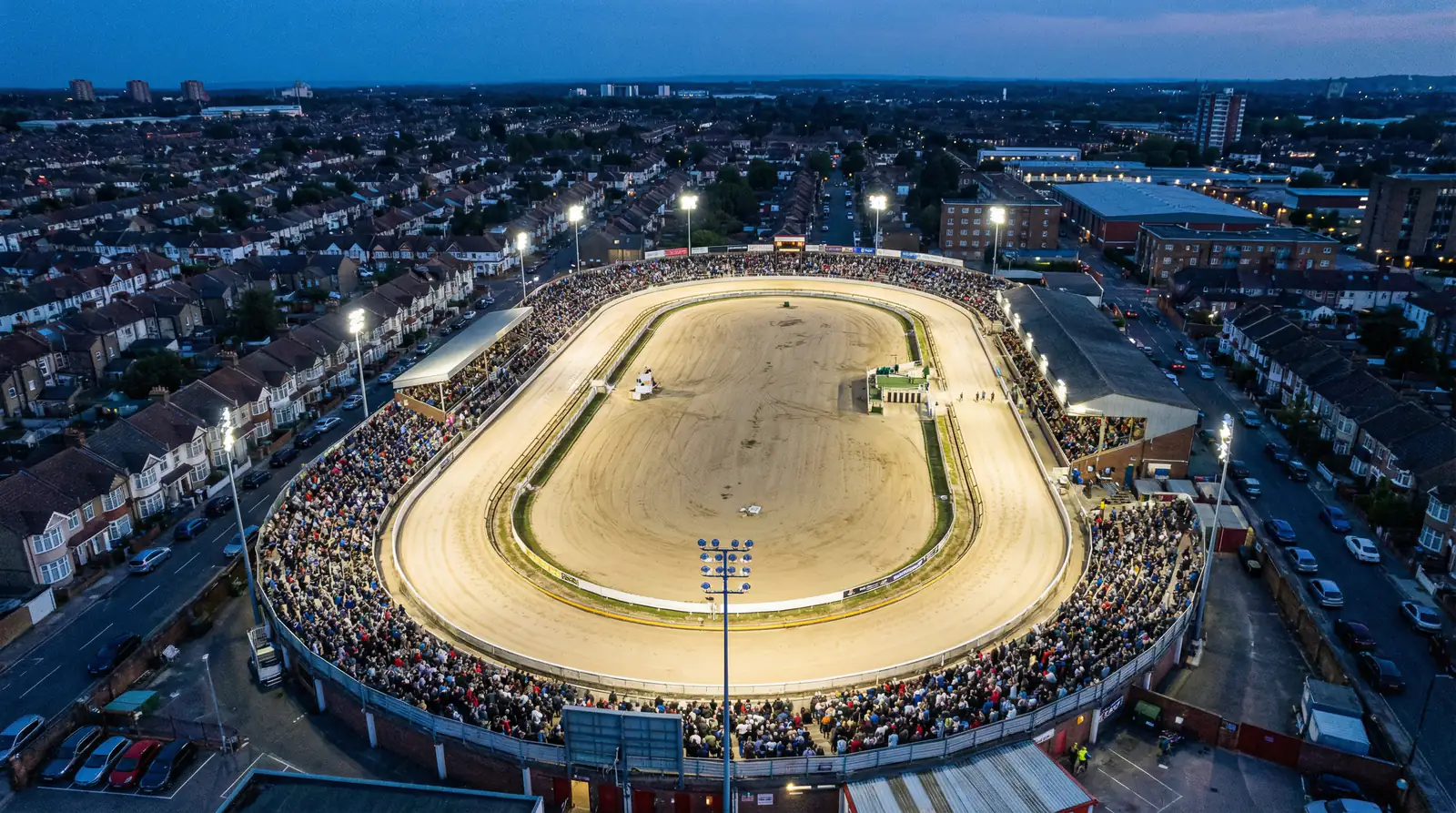
Monmore Green sits in Wolverhampton with a 419-metre circumference, a Swaffham hare system, and a first-bend run of 103 metres. These three specifications define the racing character of the track: a mid-sized oval where early pace is rewarded, the first bend is reached quickly, and the hare runs on the inside rail. Every race at Monmore is filtered through these dimensions, and dogs whose running styles suit them tend to outperform their form when transferred here, while dogs whose profiles clash with the track’s geometry tend to underperform.
The UK currently has around 20 licensed GBGB tracks, spread from Sunderland in the north to Romford and Crayford in the southeast. Each has a distinct physical profile. Some are large, galloping circuits where stamina and sustained pace matter more than trapping speed. Others are tight, sharp tracks where the first bend arrives almost immediately after the traps open. Monmore falls in the middle of this spectrum — neither the tightest circuit nor the most expansive — which gives it a balanced racing character that rewards both fast trappers and strong finishers, depending on the distance and grade.
For punters, comparing Monmore to other UK tracks is not an academic exercise. It’s a practical necessity whenever a dog appears on the Monmore card with recent form from a different venue. Understanding how the tracks differ — and what those differences mean for the dog’s likely performance — is the only way to make that form data useful.
Track Size, Bends and Surface Differences
419 metres circumference puts Monmore in the mid-range of UK greyhound tracks. Towcester is one of the largest at 420 metres around. Romford is one of the tightest at 350 metres. The circumference determines the radius of the bends: a larger track has wider, more gradual turns; a smaller track has sharper, tighter ones. Dogs that handle sharp bends well — typically smaller, lighter greyhounds with good balance — tend to excel on tight tracks. Bigger, more powerful dogs that need room to extend their stride often perform better on larger circuits.
The run to the first bend varies considerably between venues and is arguably the single most important variable in how races play out. At Monmore, the 103-metre first-bend run is moderate. At some tracks, the distance is significantly longer — over 140 metres — giving dogs more time to find their positions before the first turn. At others, it is shorter than 90 metres, making the first bend a near-instant scramble. Tracks with short first-bend runs tend to produce more congestion, more first-bend interference, and more results that are influenced by trap draw and trapping speed rather than by sustained ability. Monmore’s 103 metres sits in a zone where trap draw matters, but a fast dog from a wider trap can still reach a competitive position before the bend arrives.
Surface differences are less dramatic between UK tracks than you might expect — most licensed stadiums use sand-based all-weather surfaces — but they exist. The grade of sand, the depth of the surface, the drainage characteristics, and the maintenance regime all affect how the track runs. Monmore’s surface tends to ride consistently through most weather conditions, though heavy rain can slow the going measurably. Some tracks drain faster, producing a quicker return to standard going after wet weather. Others hold water longer, creating slower conditions that persist through an entire meeting.
The hare system also differs between tracks. Monmore uses a Swaffham hare, which runs on the inside rail. Some UK tracks use an outside hare, which reverses the running direction and changes the dynamics of the bends. Dogs that have only raced with an inside hare can sometimes be unsettled by the switch to an outside-hare track, and vice versa. This is a minor factor compared to track size and bend geometry, but it occasionally explains an unexpected result when a dog transfers between venues.
Grading and Competition Level
Romford and Crayford draw from London kennels. Nottingham pulls from the East Midlands. Monmore draws from the West Midlands and beyond. The geographic catchment of a track’s kennel base determines the depth and quality of its racing population, and this matters for grading comparisons.
A dog graded A3 at Monmore is not automatically equivalent to a dog graded A3 at Romford. The grading is track-specific, calibrated to the quality of the local dog population. Romford, with its proximity to a large number of professional kennels in Essex and southeast England, tends to have a deeper pool of high-quality dogs, which means its top grades are often more competitive than the same numerical grade at a smaller track. Conversely, a dog that has been racing in A5 at Romford might find itself competitive at A3 or A4 level at a track with a shallower talent pool.
Monmore’s position in this hierarchy is solid but not elite. The track benefits from its association with the Entain group, which brings commercial support and a consistent fixture list. The kennel base in the West Midlands is established, with several long-standing trainers who regularly produce competitive dogs. But the track does not attract the same volume of top-class entries as the flagship London venues, which means Monmore’s A1 grade is typically a step below Romford’s or Crayford’s A1 in terms of raw times and competitive intensity.
For betting purposes, this grading disparity creates both a trap and an opportunity. The trap is assuming that an A3 dog transferring from Romford will dominate at Monmore. It might, if the form translates — but the different track geometry, surface, and racing dynamics can negate the grading advantage. The opportunity is identifying dogs moving in the other direction: Monmore dogs that have been competitive at their home track and transfer to a venue where the grading is tighter. Their form might look modest in the new context, but if the track suits them, the market may undervalue them.
Why Track-Specific Data Matters for Betting
Form from one track doesn’t transfer cleanly to another. That statement sounds obvious, but it’s violated constantly by punters who treat greyhound form as universal — as though a winning time at Crayford means the same thing as a winning time at Monmore. It doesn’t, and the reasons are both physical and competitive.
The physical reasons are the track variables described above: circumference, bend radius, first-bend run, surface, hare system. A dog that runs 29.00 over 480 metres at Monmore has run 29.00 on Monmore’s specific configuration. The same dog running 480 metres at a track with tighter bends might record 29.20 because the sharper turns cost it momentum. At a track with a longer first-bend run, it might record 28.85 because it had more time to build speed before the first turn. The time is only meaningful in the context of the track where it was run.
The competitive reasons relate to grading. As noted, A3 at one track is not the same as A3 at another. A dog’s finishing position in an A3 race reflects its performance against that specific field, at that specific track, on that specific night. Transferring that result to a different venue, against a different population, requires adjustment — and most punters don’t make that adjustment, or make it poorly.
The practical implication is that Monmore-specific data is the most reliable data for betting on Monmore races. A dog with ten recent runs at Monmore gives you ten data points on the track where it’s about to race. A dog transferring from Nottingham with ten recent runs gives you ten data points from a different track that may or may not be applicable. Both dogs might appear on the same racecard with similar form figures, but the Monmore-experienced dog offers a higher degree of predictive confidence.
This doesn’t mean transferred form is useless. It means it requires extra scrutiny. When assessing a dog that has raced at other venues, ask whether the track profiles are similar, whether the grading levels are comparable, and whether the dog’s running style suits Monmore’s specific geometry. A railer from a track with a long first-bend run might struggle at Monmore, where the shorter run to the first turn compresses the time available to find the rail. A wide runner from a tight track might thrive at Monmore, where the slightly larger circumference gives more room on the outside. Track-specific analysis turns guesswork into assessment — and at Monmore, where the data is abundant and the meetings are frequent, there’s no excuse for not doing it.
Compare UK greyhound tracks on the monmoredogsresults homepage.
Read our detailed Monmore track guide in track guide.
