 Monmore dogs
 Greyhound Running Styles: Rails, Middle, Wide Explained
 Available in US
Understand greyhound running styles at Monmore. How railers, middle runners and wide runners negotiate bends, and how running style interacts with trap draw.
What Running Styles Mean in Greyhound Racing
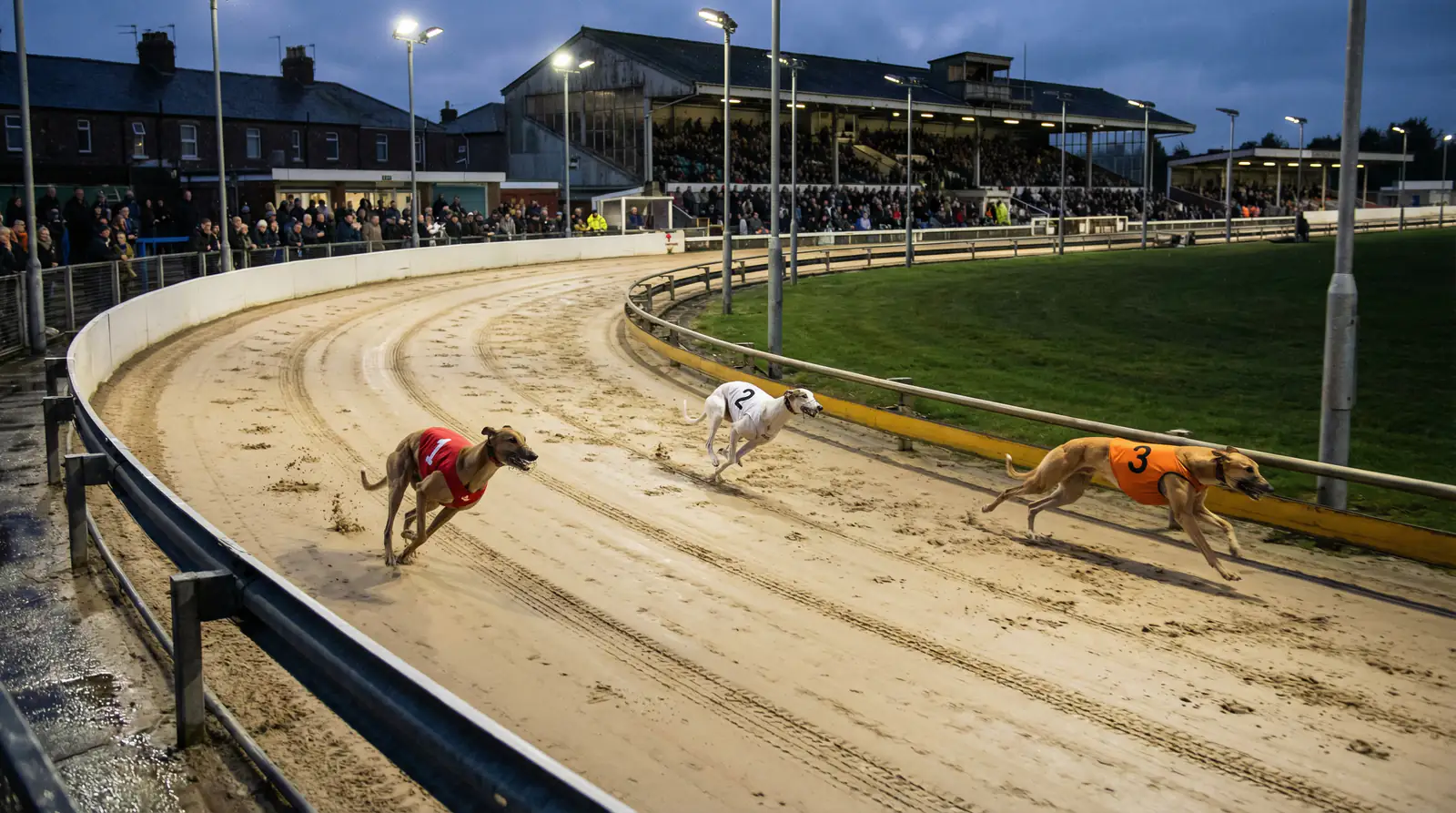
Not every dog runs the same line. In any six-dog field at Monmore, each greyhound has a natural tendency in how it negotiates the bends: some hug the inside rail, some drift to the middle of the track, and some swing wide. This preference is not random — it reflects the dog’s instinct, its racing experience, and its physical build. Understanding running styles is fundamental to reading a racecard, because the interaction between six different running preferences in the same race largely determines what happens at the first bend, and what happens at the first bend largely determines the result.
Running styles are categorised into three broad types: railer, middle runner, and wide runner. These labels appear on the racecard as part of the seeding information — abbreviated as R, M, and W — and they are assigned by the track’s racing office when the trap draw is made. The racing office tries to place railers in inside traps and wide runners in outside traps, matching the dog’s natural running line with a trap position that suits it. This seeding process isn’t always perfect, and sometimes a confirmed railer ends up in Trap 4 or a wide runner in Trap 2, but the intention is to reduce first-bend congestion by giving each dog a position that aligns with its instincts.
For punters, running style is one of the most important variables in form analysis because it interacts directly with the trap draw. A railer in Trap 1 has a natural advantage: it breaks from the inside position and wants to run on the rail, so there’s no conflict between its starting position and its preferred line. The same railer drawn in Trap 5 has a problem — it needs to cut across four other dogs to reach the rail, risking interference at the first bend. That positional mismatch doesn’t always cause trouble, but it introduces a risk that the Trap 1 draw eliminates.
Railers: Dogs That Hug the Inside
The shortest route around — if they get the rail. Railers are greyhounds that naturally run close to the inside running rail, taking the tightest possible path around every bend. Their advantage is distance efficiency: by hugging the rail, they cover less ground than any dog running a wider line. On a 419-metre circuit like Monmore, where every bend adds distance for dogs running wide, the railer’s line can save multiple lengths over the full trip.
The typical railer has a specific profile. It tends to break sharply from the traps, showing enough early pace to reach the inside rail before the first bend. It runs low to the ground on the turns, leaning into the bends rather than drifting outward. And it often has a temperament that copes with traffic — railers frequently race in close proximity to the rail and to other dogs, so a nervous or reactive greyhound rarely makes a consistent railer.
From an inside trap — 1 or 2 — a railer is in its natural habitat. The break from the traps leads directly toward the rail, the first bend can be taken on the shortest possible line, and the dog can dictate its own pace without needing to navigate around rivals. The statistics at Monmore reflect this: railers drawn in Trap 1 have a demonstrably higher win rate than the same dogs drawn in Trap 4 or 5, because the positional advantage compounds the running-style advantage.
The vulnerability of a railer is congestion. When two or three railers are drawn in adjacent inside traps, they compete for the same narrow strip of track at the first bend. The result is often bumping, checking, and lost momentum — exactly the kind of first-bend trouble that derails form figures and produces unexpected results. Races with multiple railers drawn low are inherently less predictable for the inside dogs and potentially more favourable for a wide runner in Trap 5 or 6 who avoids the traffic entirely.
For betting purposes, the ideal railer bet is a confirmed inside runner drawn in Trap 1, with no other strong railers in the field to compete for the rail position. That combination — running style matched to trap, minimal competition for the preferred line — produces the highest-probability scenarios in greyhound racing. It doesn’t guarantee a win, but it removes the positional variables that cause the most disruption.
Middle and Wide Runners
Space costs metres. Sometimes it’s worth the price. Middle runners and wide runners sacrifice the distance efficiency of the rail line in exchange for cleaner running room, and whether that trade-off is favourable depends on the race dynamics, the dog’s speed, and the trap draw.
A middle runner tends to race two or three dog-widths off the inside rail. This line avoids the congestion that railers encounter at the first bend, but it also means covering more ground on every turn. The middle-running style is often seen in dogs that have the early pace to break from the traps competitively but lack the instinct or experience to hold the rail under pressure. Some middle runners are simply dogs that haven’t settled on a preferred line — younger greyhounds in particular can oscillate between middle and wide running before their style stabilises with experience.
Wide runners swing to the outside of the track on the bends, running three, four, or even five widths off the rail. The distance penalty is real — a wide runner covers measurably more ground than a railer over 480 metres — but the advantage is unimpeded racing. A wide runner from Trap 6, with clear space on the outside, can accelerate through the first bend without any risk of interference. If the inside traps are occupied by fast railers competing for the rail, the wide runner is the dog most likely to navigate the first turn without losing momentum.
The key metric for evaluating wide runners is whether their raw speed compensates for the extra distance. A wide runner that can maintain 29.00-second pace over 480 metres despite covering more ground than a railer is a genuinely fast dog — its true ability is better than the finishing time suggests, because the time includes a distance penalty. Conversely, a wide runner finishing in 29.50 might be running no faster than a railer finishing in 29.30 once the extra distance is factored in.
In practice, middle and wide runners are most dangerous in races where the inside is crowded. If three railers are drawn in Traps 1, 2, and 3, and a fast wide runner is in Trap 6, the wide runner has a structural advantage — it avoids the traffic that will slow the inside dogs and can take the first bend at full speed. Reading these dynamics from the racecard, before the race is run, is one of the core skills of greyhound form analysis.
How Running Style Interacts with Trap Draw at Monmore
A wide runner from Trap 1 faces a different challenge than a wide runner from Trap 6, and that difference is not trivial. The interaction between running style and trap draw is the single most important dynamic in greyhound racing at Monmore, and it determines the shape of nearly every race before the traps open.
The ideal alignment is straightforward: railer in Trap 1 or 2, wide runner in Trap 5 or 6, middle runners in Traps 3 and 4. When the seeding works out this way, each dog’s natural line leads it away from the others at the first bend, reducing congestion and producing a race that is largely decided by ability rather than fortune. The racing office at Monmore aims for this alignment, but entries don’t always cooperate — sometimes the field contains four railers and two wide runners, or three middle runners with no obvious wide runner at all.
When alignment breaks down, opportunities appear. A wide runner drawn in Trap 2, for instance, faces a positional conflict. Its natural instinct is to swing wide, but from an inside draw it must first cross behind or through dogs running on the rail or in the middle. This creates early-race interference that slows the wide runner and disrupts the dogs around it. The racecard tells you this will happen — you can see the running style and the trap — and it allows you to downgrade that dog’s chances and upgrade the prospects of runners with cleaner positional setups.
The reverse scenario — a railer drawn in Trap 5 — is equally problematic. The dog wants the rail but starts wide of it. It will attempt to cut across the track toward the inside, and in doing so it may check middle runners or force wide runners even wider. The result is often first-bend chaos that benefits whichever dog happened to find open space, regardless of form.
At Monmore specifically, the 103-metre run to the first bend creates a compressed window for these style-versus-trap conflicts to play out. On tracks with longer home straights before the first turn, dogs have more time and space to sort themselves into their preferred positions. At Monmore, the sorting happens fast, and dogs with mismatched style-trap combinations often don’t resolve their positional problem before the bend arrives. This makes the trap draw at Monmore more consequential than at tracks with longer runs to the first bend, and it means that running style analysis — combined with trap position — is proportionally more valuable here than at almost any other UK venue.
Analyse greyhound running styles on the monmoredogsresults homepage.
Factor in trap statistics when assessing running positions in trap statistics.
