 Monmore dogs
 Understanding Greyhound Sectional Times for Betting
 Available in US
Learn how greyhound sectional times work at Monmore. First-bend splits, mid-race sections and finishing speed analysis to compare dogs and find betting value.
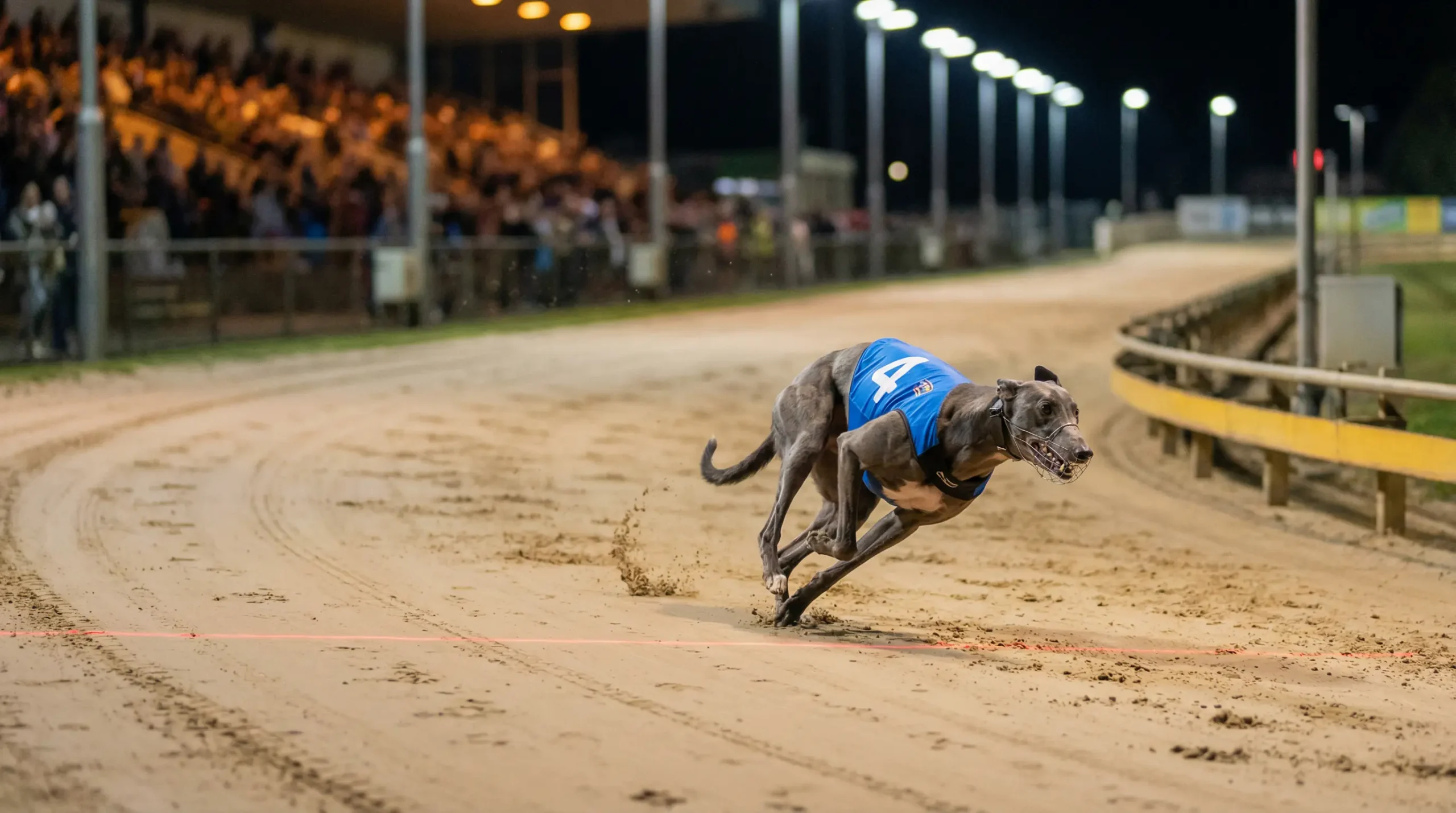
What Are Sectional Times in Greyhound Racing?
The overall time is one number. Sectionals give you three. In a standard 480-metre race at Monmore, the finishing time tells you how long the dog took to complete the full trip. Sectional times break that single figure into segments — typically the time to the first bend, the time through the middle section, and the time from the final bend to the finish — revealing the shape of the run in a way that the overall clock cannot.
A dog that finishes in 29.00 has run a fast race. But without sectionals, you can’t tell whether it led from the traps and held on through the final straight, or whether it was three lengths behind at the first bend and produced a devastating finishing burst. Both scenarios produce the same overall time, but they describe completely different types of performance. The first dog is a front-runner that needs a clean break. The second is a closer that can overcome early trouble. These are distinct animals with distinct prospects depending on the trap draw, the opposition, and the pace dynamics of their next race.
Sectional timing at UK greyhound tracks uses a system of timing beams placed at specific points around the circuit. At Monmore, the key split is the time from the traps to a point near the first bend — a measurement that captures the dog’s trapping speed and early pace. A second beam, positioned further around the track, provides the mid-race section. The finishing time completes the picture. Together, these three figures decompose a 29-second race into phases that can be analysed independently.
For punters, sectional times are the single most underused form tool in greyhound racing. Most bettors look at the finishing time and the result. Fewer examine the sectionals. The ones who do are working with a richer dataset that reveals pace profiles, stamina reserves, and tactical characteristics that the finishing time alone conceals.
First-Bend Sectional: The Critical Split
Dogs that lead at the first bend win disproportionately. That is one of the most robust statistical findings in greyhound racing, and it applies at Monmore with particular force because the 103-metre run from traps to first bend is short enough that early pace — the ability to break fast and reach the turn in front — translates directly into race advantage.
The first-bend sectional measures exactly this. It records the time from the trap opening to the dog reaching the first bend marker, and it tells you how quickly the dog covered that critical opening section. A fast first-bend split, relative to the field, usually corresponds to leading at the turn. A slow split usually means the dog was behind, facing traffic, and needing to find room on the inside or outside to make progress.
At Monmore’s 480-metre distance, a strong first-bend sectional might be in the region of 3.70 to 3.90 seconds, depending on the going and the grade. Dogs that consistently record splits in that range are natural front-runners — they break fast, reach the first bend in the lead or close to it, and dictate the race from that point. Dogs with first-bend sectionals above 4.10 or 4.20 are typically closers — they concede early ground and rely on superior stamina or finishing speed to make up the deficit.
The predictive value of the first-bend sectional is highest at sprint distances and standard distances. Over 264 metres, the first-bend split accounts for a larger proportion of the total race time, and the dog that leads at the first turn has fewer bends remaining in which to be overtaken. Over 480 metres, leading at the first bend is a major advantage but not a guarantee — a closer with exceptional finishing speed can still win from behind if the front-runner fades. Over staying distances, the first-bend sectional is less decisive, because the extended race gives multiple opportunities for position changes.
For practical betting purposes, comparing first-bend sectionals across a racecard’s entries is one of the most direct methods of predicting the early pace shape. If one dog has a first-bend split 0.20 seconds faster than any rival, that dog is likely to lead. If three dogs have similar first-bend splits, the first bend is likely to be congested. Both outcomes shape the race’s dynamics, and both are readable from the sectional data before the traps open.
Using Sectionals to Compare Dogs Across Races
Raw times vary by night. Sectionals isolate performance. This distinction is what makes sectional analysis a superior tool to overall time comparison, particularly when you’re evaluating dogs that have raced on different nights under different going conditions.
Consider two dogs both entered in tomorrow’s 480-metre race at Monmore. Dog A ran 29.00 last Thursday. Dog B ran 29.10 last Saturday. On the surface, Dog A is faster. But last Thursday’s going was fast and the entire card ran quick — the average winning time across all 480-metre races was 29.20. Last Saturday was slower going, with the card average at 29.60. Dog B’s 29.10 on slow going was 0.50 seconds faster than the card average. Dog A’s 29.00 on fast going was only 0.20 seconds faster than its card average. In context, Dog B’s performance was the more impressive, even though the raw number was slower.
Sectional times allow you to take this analysis further. If Dog A’s first-bend split was 3.80 and Dog B’s was 4.05, Dog A has a natural early-pace advantage. But if Dog A’s final-section split was 10.20 while Dog B’s was 9.80, Dog B is the stronger finisher. The overall times were separated by a tenth of a second, but the sectional breakdown reveals two different runners: one that relies on trapping speed, another that relies on a closing kick. Which profile is better for tomorrow’s race depends on the trap draw, the likely early pace from the rest of the field, and the distance.
Sectional comparison is also useful for identifying improving dogs. A greyhound whose finishing splits have been getting progressively faster over its last three runs may be improving in fitness or responding to a change in training method. The overall times might look static, because the improvement in the final section is offset by a slightly slower early pace. But the sectional data reveals a trend that the headline figure masks — and that trend might mean the dog is about to put together a complete performance where the fast finish combines with a clean break.
The limitation of sectional comparison is data availability. Not every platform publishes sectional times for every race, and the consistency of recording varies. When the data is available, though, it offers a layer of analysis that most punters never access — a genuine informational edge that the finishing time alone cannot provide.
Where to Find Sectional Data for Monmore
Timeform and the Greyhound Recorder both publish sectional times for Monmore meetings, and between them, they cover the vast majority of races at the track. Knowing where to find this data — and how each platform presents it — is the practical final step in making sectionals part of your form analysis.
Timeform includes sectional data within their full result pages for each race. The first-bend time is recorded alongside the finishing time and run comment, and Timeform’s adjusted time calculation uses the sectional data as part of its methodology for producing a standardised performance figure. For punters who subscribe to Timeform’s premium greyhound service, the sectional data is integrated into the dog’s full form profile, meaning you can view sectional trends over multiple runs without manually compiling the figures.
The Greyhound Recorder, based in Australia but covering all GBGB-licensed tracks, provides a more granular sectional breakdown. Their result pages include run-position data at multiple points in the race — not just the first bend, but positions at subsequent bends as well. This positional mapping, combined with the timing splits, gives a complete picture of how each dog moved through the field. For analytical punters who build spreadsheet models, the Recorder’s data format is among the most detailed publicly available.
At The Races also publishes sectional times for some meetings, though their coverage is less comprehensive than Timeform’s for greyhound racing specifically. The Racing Post includes form figures that reference early pace and run style, but their sectional timing data is less prominently displayed.
For punters who want to use sectionals regularly, the most efficient method is to pick one platform — Timeform is the most consistent for UK greyhound data — and build the habit of checking sectional splits every time you review a Monmore result. Over weeks and months, this builds a mental model of what constitutes a fast or slow split for each distance and grade at the track. That calibration, accumulated through consistent attention to the data, is what turns sectional times from an interesting statistic into a practical betting tool.
Master sectional times analysis on the monmoredogsresults homepage.
Apply sectional data to your overall form analysis in form analysis.
