 Monmore dogs
 Ladbrokes Gold Cup at Monmore: History and Betting
 Available in US
History and betting guide for the Ladbrokes Gold Cup at Monmore Green. Race format, notable winners, ante-post markets and final-night betting strategy for this flagship event.
Gold Cup Origins: From Midland Gold Cup to Ladbrokes
The name changed. The prestige didn’t. The Ladbrokes Gold Cup at Monmore Green is the stadium’s flagship competition — the race that draws open-class fields, attracts regional and national attention, and carries the kind of prize money that trainers target months in advance. Its history stretches back decades under various sponsorship names, but the core identity has remained constant: this is Monmore’s marquee event, and winning it matters.
The competition was originally known as the Midland Gold Cup, a title that reflected its geographic scope and its position as the premier greyhound race in the West Midlands. The Midland Gold Cup established Monmore as more than a local track — it gave the stadium a flagship event that attracted entries from kennels beyond Wolverhampton’s immediate catchment, drawing dogs from across the region to compete for a title with genuine recognition in UK greyhound racing circles.
When Ladbrokes acquired naming rights — part of the bookmaker’s broader involvement with Monmore through the Entain ownership of the stadium — the race gained both commercial weight and wider visibility. Ladbrokes’ promotion of the Gold Cup through their retail and online platforms brought the competition to an audience that might never have followed a race at Monmore otherwise. The sponsorship didn’t alter the race’s format or entry criteria, but it embedded the event within a national betting framework that ensured coverage, odds markets, and media attention.
The Gold Cup’s evolution mirrors the broader trajectory of UK greyhound racing: from a predominantly local spectator sport to a commercially driven betting product with national reach. Monmore’s adaptation to that shift, with the Gold Cup as its centrepiece, has kept the stadium relevant in an industry where many historic venues have closed. The race is both a competition and a statement: Monmore’s proof that it can stage world-class greyhound racing on the same circuit that hosts Monday afternoon BAGS fixtures.
Race Format: Distance, Heats and Finals
480 metres, open class — the best dogs in the Midlands, and sometimes beyond. The Ladbrokes Gold Cup is contested over Monmore’s standard distance, which means the race tests the full range of greyhound racing attributes: trapping speed, first-bend positioning, sustained pace through the middle section, and finishing speed over the final 100 metres.
The competition is structured in rounds. An initial heat stage, typically comprising four to six heats, reduces the entry field to a final of six dogs. The heats are run on one evening, and the final is staged the following week — giving trainers a seven-day window to manage their dogs’ recovery and preparation. Each heat is a genuine race, not a time trial, and the finishing positions determine which dogs progress. The top two from each heat typically advance to the final, though the exact qualification criteria can vary by year depending on the size of the entry.
Open class means there are no grading restrictions on entries. A Gold Cup heat might feature an A1 regular alongside a dog that has been competing in open races at Romford or Nottingham. The entry criteria focus on ability rather than current grade, which is what gives the competition its depth. Trainers who believe they have a dog capable of competing at the highest level can enter regardless of the grade it has been racing in week to week — though in practice, the entries are dominated by dogs already established in the top two or three grades at their home tracks.
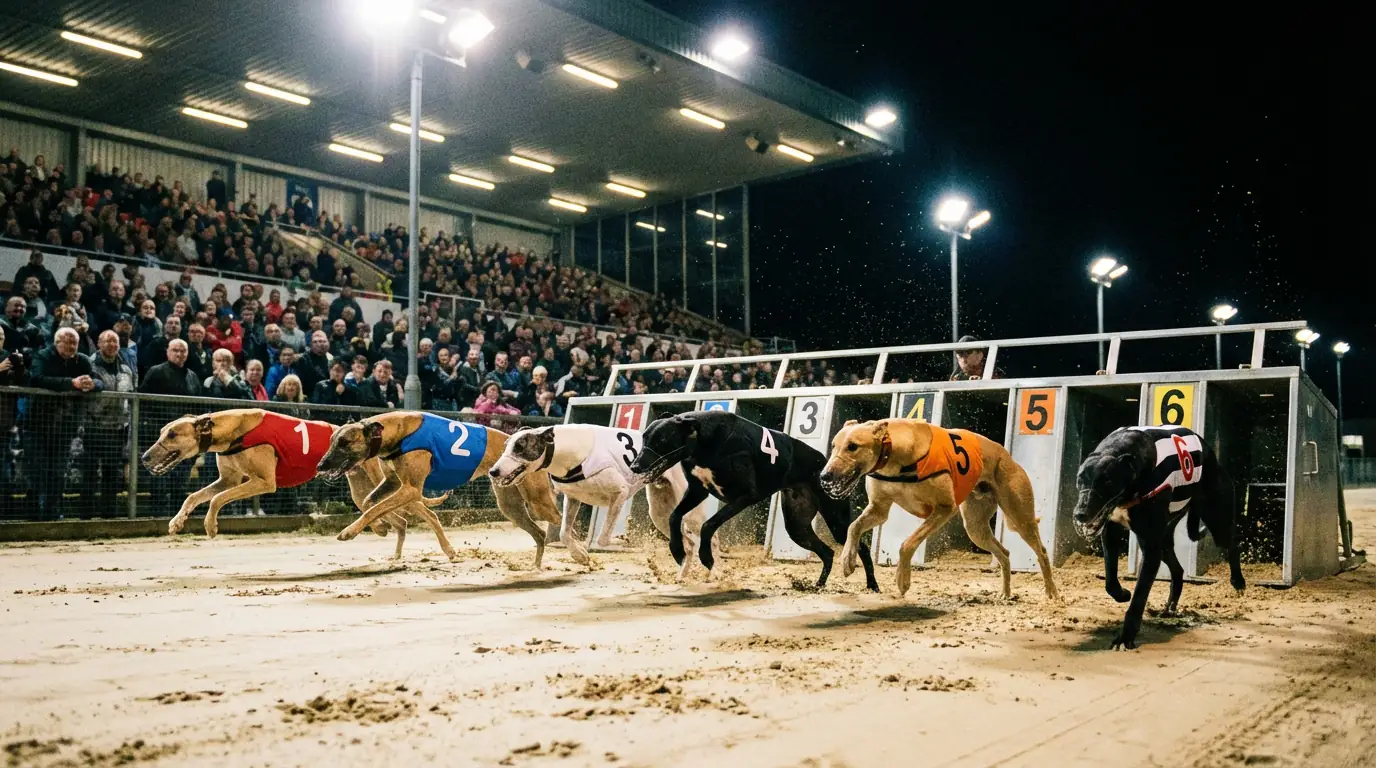
The final is the Saturday evening centrepiece. Six dogs, one race, and a result that carries weight in the dog’s career record. Winning the Ladbrokes Gold Cup at Monmore is a significant line on any greyhound’s record, and for trainers based in the Midlands it represents the most prestigious local title available. The atmosphere in the stadium for the final is markedly different from a regular Saturday night — fuller stands, louder crowd, and a sense of occasion that the weekly programme doesn’t replicate.
Notable Winners and Memorable Finals
The Gold Cup’s roll of honour includes dogs that have gone on to — or arrived from — the highest levels of UK greyhound racing. Some winners were already established champions, using Monmore’s flagship event as another trophy in a glittering career. Others announced themselves here, producing a performance that marked them as dogs to follow at the sport’s elite level.
The finals that live longest in memory tend to share a common quality: drama at the first bend. On a 480-metre track where the run to the first turn is 103 metres, the Gold Cup final often produces the most intense first-bend contest of the entire Monmore calendar. Six open-class dogs, every one of them fast, every one of them trained to peak for this night, breaking from the traps with zero margin for error. The dog that emerges from that first bend with its nose in front has usually done the hardest part of the job — but not always.
Memorable Gold Cup finals have also produced upsets that reshaped the pre-race betting market in seconds. A heavily backed favourite caught in traffic at the first bend, an outsider drawn in Trap 6 finding a clear outside run and never being headed, a photo finish where the winner was separated from the second dog by a pixel on the timing camera. These moments are what give a competition its mythology, and Monmore’s Gold Cup has accumulated enough of them over the decades to justify its place as a fixture that serious greyhound racing followers mark in their calendars.
The historical record of Gold Cup winners also provides useful form data. Dogs that have won or placed in the final tend to perform well in subsequent open-class events at Monmore, because the final represents a genuine test of class over the track’s standard distance. A dog’s Gold Cup run — its time, its trap performance, its finishing effort — becomes a benchmark figure for evaluating its chances in every future race at the venue.
Betting on the Gold Cup: Ante-Post and Night Of
Ante-post prices drop fast once the heats are drawn. The Gold Cup betting market opens in two distinct phases, and understanding the dynamics of each can make the difference between capturing value and paying over the odds for a selection that the market has already fully assessed.
The ante-post phase begins when the entries are published, usually one to two weeks before the heats. At this stage, bookmakers price the full entry field for the outright Gold Cup winner, and the odds reflect a combination of the dogs’ general form, their perceived class, and the bookmaker’s initial assessment of how the competition might unfold. Ante-post prices are typically the most generous available, because the market is trading on limited information — the heat draws haven’t been made, the going for the night is unknown, and the dogs haven’t been seen in their pre-competition trials.
Once the heat draws are published, the market adjusts. A strong dog drawn in Trap 1 for a heat with favourable opposition might shorten from 8/1 to 5/1 overnight. A fancied dog drawn in Trap 5 in the toughest heat might drift from 4/1 to 7/1. The draw is a significant variable in any greyhound race, and in a competition where the margins are as tight as the Gold Cup, it can reshape the entire market. Punters who back ante-post before the draw are gambling on the draw as well as the form — a double uncertainty that explains why ante-post prices are higher.
On the night of the final, the market is at its most efficient. The heats have been run, the finalists are known, the draw has been made, and the going can be assessed from the earlier races on the card. The betting public, including sharp money from professional punters, has the maximum amount of information available. This means the prices are tighter and finding value is harder than at any earlier point in the competition.
The strategic approach depends on your risk appetite. If you have a strong opinion on a dog before the heat draw, ante-post offers the best prices but carries the risk of an unfavourable draw or a heat elimination. If you prefer to wait, the final-night market gives you maximum information but minimum generosity. The middle path — betting after the heat draw but before the heats are run — captures some ante-post value with less draw uncertainty, and it’s the window where experienced Gold Cup bettors often find their best opportunities.
Follow the Ladbrokes Gold Cup on the monmoredogsresults homepage.
Check the full racing calendar around this event in racing calendar.
