 Monmore dogs
 Monmore Track Records: Fastest Times by Distance
 Available in US
Complete list of Monmore Green track records by distance. Record holders, conditions behind record-breaking runs and near-miss performances at the Wolverhampton greyhound stadium.
Current Track Records at Monmore Green
Every distance has a number that no dog has beaten. At Monmore Green, those numbers define the absolute ceiling of performance for each race trip, and they serve as permanent reference points against which every subsequent run can be measured.
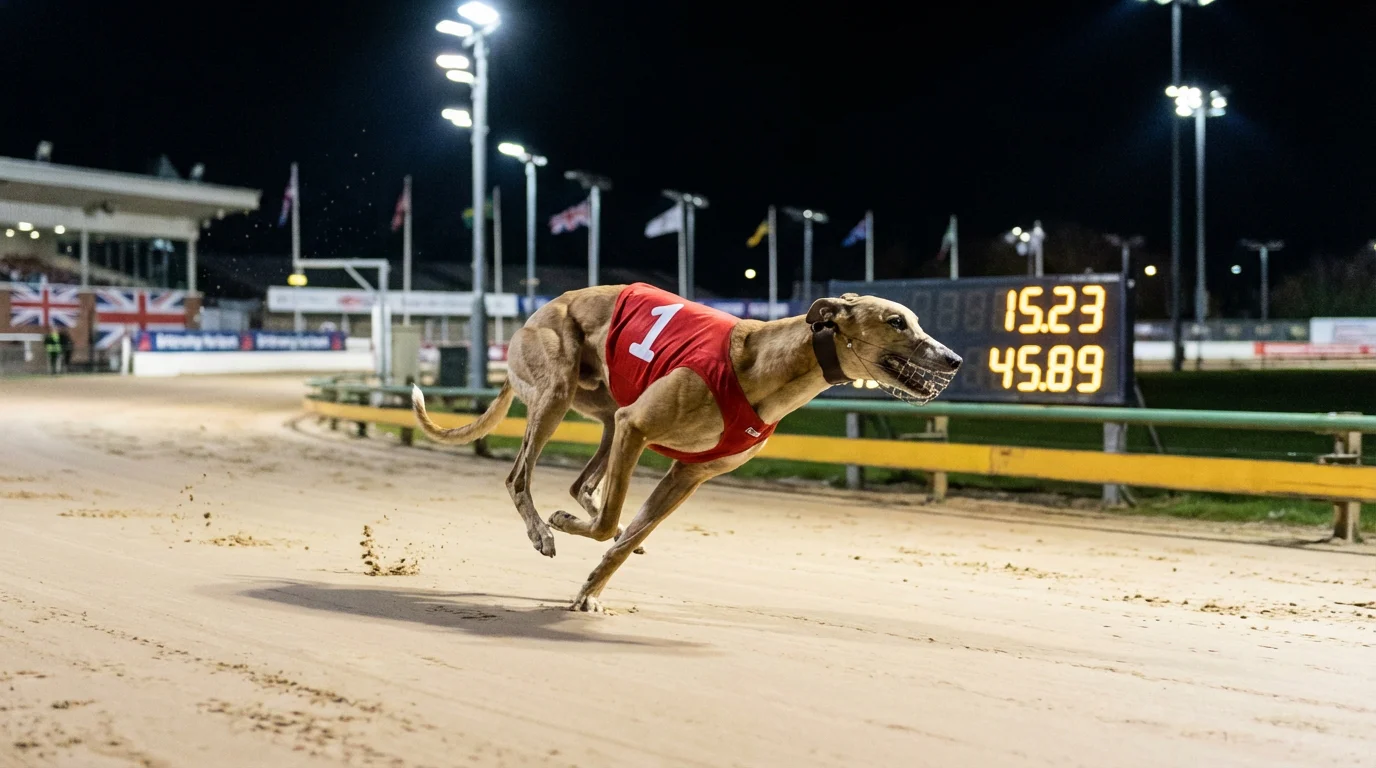
Track records at Monmore exist for each of the standard racing distances: 264 metres, 480 metres, 630 metres, 684 metres, and 835 metres. The 480-metre record carries the most weight, because the standard distance accounts for the vast majority of races run at the track. It is the time that every trainer, every form analyst, and every serious punter knows, even if they can’t name the dog that set it. The sprint record over 264 metres is the flashiest — the shortest possible time at the track, set in a race that barely lasts 15 seconds. The staying records, over 684 and 835 metres, are the least frequently challenged, because staying races are programmed far less often than standard and sprint events.
Records at UK greyhound tracks are ratified by the Greyhound Board of Great Britain and require official timing verification. The time must be recorded under standard race conditions — a competitive fixture, not a trial or a time-only run — with the timing system functioning correctly and no dispute over the result. This means that exceptionally fast trial times, which occasionally surface in kennel whispers and online forums, do not count. The record must be set in anger, under race-day conditions, against real opposition.
For punters, the track record is less a target to bet toward and more a contextual marker. When a dog runs within half a second of the record at a given distance, that performance is exceptional regardless of the grade. When a dog runs two seconds off the record, the time alone tells you it was competing at a level well below the track’s peak. The gap between a dog’s recent times and the track record provides a rough but useful measure of where that dog sits in the hierarchy of Monmore’s racing population.
Record Holders and Their Races
Records aren’t just times — they’re stories. Every track record at Monmore was set on a specific night, in a specific race, under conditions that aligned to produce a performance that has not been equalled since. The dog that holds a record ran the race of its life, and the circumstances around that run are usually as instructive as the time itself.
Record-setting performances tend to share certain characteristics. The dog almost always led from the first bend — front-runners have a natural advantage in producing fast times because they take the shortest path and encounter no interference. The trap draw is frequently favourable, with the record holder breaking from an inside position or from a wide trap with clear running room. And the opposition, while genuine, is often spread enough across the track that the record setter was able to run its own race without being bumped, checked, or forced wide.
The trainer behind a record-breaking dog is part of the story too. Records at Monmore have historically been associated with kennels that understand the track’s specific demands — the run to the first bend, the character of the sand surface, the way different going conditions affect speed. A trainer who has produced multiple record-challenging performances knows how to time a dog’s peak fitness to coincide with the right conditions, and that combination of preparation and circumstance is what separates a record from a near-miss.
What makes record holders interesting from a form perspective is that their performances represent outlier events. The record time was not the dog’s average — it was the upper limit. Most record holders ran significantly slower than their record in the majority of their other races. The record captures a moment where everything — fitness, conditions, opposition, running line — aligned simultaneously. Understanding that context prevents the mistake of treating the record time as a reasonable expectation for any dog in any race.
How Records Are Set: Conditions and Context
Most records fall on specific kinds of nights. The conditions required for a record-breaking run are more predictable than the run itself, and knowing what those conditions look like helps you recognise when a meeting might produce something exceptional.
The going is the single most important factor. Track records at Monmore are almost exclusively set on fast going — dry sand that has been well prepared, firm underfoot, offering minimal resistance to the dogs. Heavy or wet going slows every runner, and it is virtually impossible for a record to fall when the surface is holding water. The fastest times at any track correlate tightly with the driest, firmest conditions. At Monmore, where the sand surface is managed by the stadium’s ground staff and can be watered or harrowed between meetings, the going on a dry summer evening with no recent rainfall is the likeliest setting for a record attempt.
Wind plays a secondary but measurable role. A tailwind on the home straight — the final section of the race — can shave hundredths of a second from a finishing time. Conversely, a headwind on the same stretch adds time. Monmore’s semi-urban location in Wolverhampton means wind conditions vary but are rarely extreme, and the stadium’s banked terracing provides some shelter. Even so, a still night is preferable for record pursuit.
The grade of the race matters too. Records are almost always set in open or high-grade events — A1 or A2 at minimum — where the dog quality is sufficient to produce genuine pace from the traps. A record set in an A8 race would be extraordinary to the point of implausibility, because the dogs competing at that level simply don’t possess the raw speed needed. The racing calendar’s major competitions, staged on Saturday evenings with full crowds and fast going, are the occasions when records are most likely to be threatened.
Temperature has a minor influence. Greyhounds tend to perform slightly better in moderate conditions — not too hot, not too cold. Extreme heat can slow dogs, and very cold nights can affect the surface and the dogs’ muscles. The temperate British summer, with evening temperatures between 15 and 20 degrees Celsius, is the sweet spot for peak greyhound performance. Most records across UK tracks are set between May and September.
Near-Misses: Times Worth Noting
The record that stands is as interesting as the one that almost didn’t. For every track record at Monmore, there are performances that came within hundredths of a second — runs that would have been the new benchmark if conditions had been fractionally different or if the dog had found one more length of speed in the final stride.
Near-misses matter to punters because they identify dogs that are operating at the very top of Monmore’s performance range. A dog that runs within 0.10 seconds of the track record — even if it doesn’t break it — is demonstrating a level of ability that places it in the elite tier of the track’s population. That information is valuable when the same dog appears on the next racecard, because it tells you the ceiling of what this animal can produce under favourable conditions.
Near-misses also reveal something about the track’s competitive cycle. Periods when multiple dogs are running close to the record suggest that the overall quality of the Monmore population is high — the kennels are strong, the dogs are fit, and the racing office is programming competitive fields. Periods when the best times are a full second or more behind the record indicate a leaner phase. These cycles are natural — kennel rosters turn over as dogs retire and new ones arrive — and recognising them helps calibrate expectations for the current season’s racing.
One practical use of near-miss data is in evaluating time figures on racecards. If the current 480-metre record is, say, 28.20, and a dog on tomorrow’s card has recent times of 28.45 and 28.50, you know that dog is running within three-tenths of the all-time best. That’s elite form by any measure, and it should be weighted accordingly when comparing against rivals whose recent times are 29.00 or slower. The gap between 28.45 and 29.00 might look like just over half a second on paper, but it represents the difference between a dog challenging the record and a dog racing in a different performance class entirely.
Tracking near-misses over time also tells you whether the record itself is vulnerable. If three or four dogs have run within 0.15 seconds of the 480-metre mark over the past year, the record is under genuine pressure and could fall at any meeting where conditions align. If nobody has come within half a second in the same period, the record is safe for now — and the dog that set it was exceptional rather than a product of a fast era.
Find Monmore track records on the monmoredogsresults homepage.
Compare record times with going conditions in going conditions.
