 Monmore dogs
 Greyhound Grading System Explained for Monmore
 Available in US
Greyhound grading system at Monmore explained. A1 to A10 grades, distance prefixes, how dogs move between grades, and using grade changes as betting opportunities.
What Is Greyhound Grading?
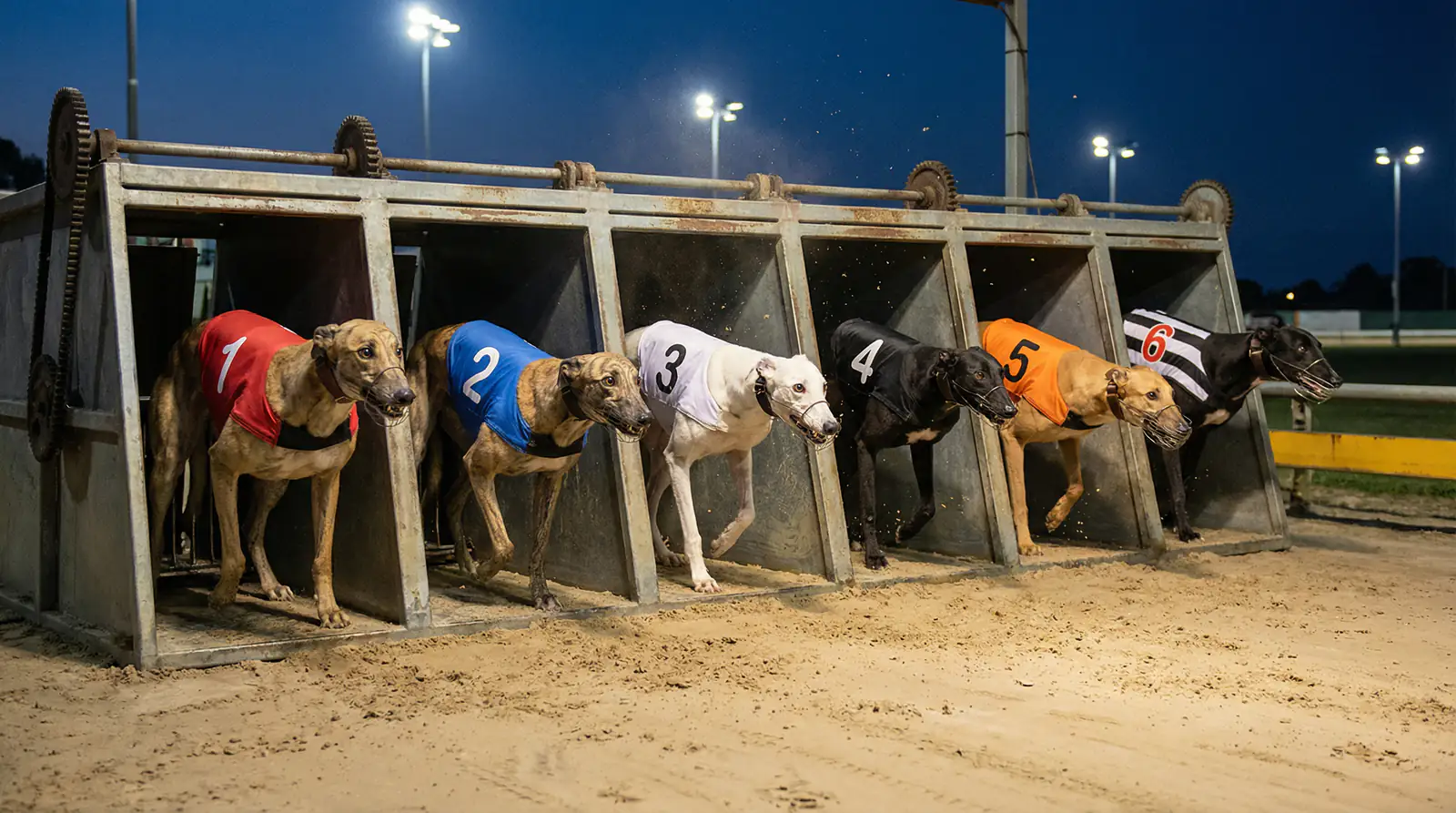
The grading system is how greyhound racing organises competition. It functions as a league structure: dogs are placed in grades based on their recent performance, and races are restricted to dogs of the same grade so that the runners are competitive with each other. Without grading, the fastest dogs in the stadium would win every race, slower dogs would never have a chance, and betting markets would be meaningless because the outcome would be obvious before the traps opened.
At Monmore, the grading system uses a letter-number format that identifies both the distance and the competitive level. The letter prefix indicates the distance category: A for standard races over 480 metres, D for sprint races over 264 metres, and S for staying races over longer distances. The number indicates the grade level within that category, with lower numbers representing higher ability. A1 is the top standard-distance grade at Monmore — the best 480-metre dogs on the track. A10 is the lowest, reserved for dogs with the weakest recent form over that distance.
Open races sit above the grading structure entirely. An open race has no grade restriction, meaning the best dogs from any grade can be entered. These are typically the highest-quality races on the card and are reserved for named competitions, special events, or feature races where the racing office wants to assemble the strongest possible field. The Ladbrokes Gold Cup at Monmore is run as an open-class competition, and the dogs that contest it are drawn from the top of the grading ladder.
The grading system is managed by the racing office at each track, operating under GBGB rules that standardise the principles of grading across all licensed venues. The specific number of grades and the criteria for movement between them vary slightly from track to track, but the fundamental logic — better recent form pushes a dog up, weaker form pulls it down — is consistent everywhere.
How Grades Work at Monmore: Distance Prefixes and Levels
The full grading structure at Monmore covers multiple distances and multiple ability levels within each distance. Understanding the prefixes and numbers is essential for reading the racecard, because the grade of a race tells you immediately what calibre of dog you’re assessing and what standard of performance to expect.
Standard-distance races over 480 metres carry the A prefix. This is the largest category at Monmore, covering the majority of races on any given card. The grades run from A1 at the top to A10 or lower at the bottom, though the exact number of active grades depends on the current dog population at the track. A1 to A3 represent the top tier — dogs running times consistently under 29 seconds and competing at the highest level available in regular graded racing. A4 to A6 is the competitive middle ground where the bulk of Monmore’s weekly action takes place. A7 and below represents dogs with less impressive recent form, often young dogs working their way up or older dogs whose ability has declined from a higher peak.
Sprint races over 264 metres use the D prefix. The sprint grades follow the same numerical logic as the standard grades, but the dog population in sprints is smaller, so the range of grades is narrower. Sprint dogs at Monmore are specialists — fast from the traps, explosive over a short distance, and often less effective at standard distances. The D-grade races tend to feature more front-running and more decisive results, because the sprint distance leaves less room for a dog to recover from a slow start or an unfavourable first-bend position.
Staying races over 630 metres, 684 metres, or longer distances use the S prefix. Staying dogs require stamina and sustained pace rather than pure sprint speed, and the staying grades identify dogs whose ability suits these longer trips. Staying races at Monmore are less frequent than standard or sprint races but appear regularly on the card, particularly on evening meetings where the programme includes a wider variety of distances.
The racecard for any Monmore meeting lists the grade of each race alongside the distance, so you can see at a glance whether you’re looking at an A3 standard race, a D2 sprint, or an S4 staying event. The grade contextualises the form: a finishing time of 29.20 means something very different in an A2 race than in an A8 race, because the quality of opposition the dog has beaten to record that time varies enormously between the two levels.
How Dogs Move Between Grades
Grading is not static. Dogs move up and down the grading ladder based on their recent results, with the racing office at Monmore reviewing performances after each meeting and making grade adjustments for the following week’s card. The rules governing these movements are standardised by the GBGB, though the racing office has some discretion in applying them.
The basic principle is that winning moves a dog up and losing moves it down. A dog that wins an A5 race will typically be reassessed and may be moved to A4 for its next start. A dog that finishes last in A5, particularly if it has done so in consecutive races, will likely be dropped to A6. The magnitude of the move — one grade, two grades, or no change — depends on the margin of victory, the quality of the race, and the dog’s recent trajectory. A dog that wins by six lengths in a fast time is more likely to be jumped two grades than one that wins by half a length in a moderate time.
The racing office also considers a dog’s overall grade history when making adjustments. A dog that was graded A2 six months ago, dropped to A5 through a sequence of poor results, and has now won at A5 might be moved straight to A3 rather than A4, because its recent A2 history suggests it is capable of competing at a level higher than its current grade implies. This kind of accelerated promotion reflects the racing office’s judgement that the dog’s recent poor form was a temporary dip rather than a permanent decline.
For punters, grade movements are one of the most valuable form indicators available. A dog dropping in grade — moving from A4 to A5, for example — is facing weaker opposition than it encountered in its recent races. If the drop is due to a run of bad luck (crowding, poor draws, going changes) rather than a genuine decline in ability, the dog might be significantly better than its new grade competitors. This scenario — a good dog in a lower grade — is one of the most reliable value angles in greyhound racing.
Conversely, a dog moving up in grade is stepping into stronger company. Its recent form looks impressive because it was achieved against weaker opposition, and the question is whether that form translates to the higher level. Some dogs handle the grade rise comfortably and continue winning. Others are exposed by the faster pace and better quality at the new level, and their form deteriorates. The market doesn’t always price this transition accurately, which creates both risks and opportunities depending on your assessment of the dog’s true ability.
Grade Changes as Betting Opportunities
The predictable pattern of grade changes creates systematic betting angles that the market routinely underprices. Dogs dropping in class and dogs returning from an absence to a lower grade are the two most consistent sources of value in regular graded racing at Monmore.
A dog dropping in class has a form record that includes races against better opposition. Its finishing positions may look modest — third or fourth in A4 — but those positions were achieved against A4-quality dogs. When the same dog lines up in A5, it is facing a field of runners whose recent form was achieved against A5 opposition, which by definition is a lower standard. The dropper’s recent times, even if they were behind the winner, may be faster than anything the A5 field has produced. Checking the actual times, not just the finishing positions, is how you identify the droppers whose class advantage is real.
Dogs returning from absence present a different opportunity. When a dog has been off the track for several weeks — through injury, rest, or a kennel break — it returns to racing at a grade that reflects its pre-absence form, which may have deteriorated during the layoff, or may actually be stronger if the rest has allowed recovery. The market typically treats returners with suspicion, offering longer odds than the dog’s ability merits, because the form figures show a gap and the betting public prefers recent, visible data to assumptions about fitness.
Not every class dropper wins, and not every returner is refreshed. The key is to identify the ones where the grade change creates a genuine mismatch between the dog’s ability and its competition, and where the market’s odds reflect the grade rather than the ability. A dropped dog at 3/1 in an A5 race, when its A4 form suggests it should be 2/1, is a value bet. The same dog at even money in A5 is not, because the market has already priced in the class advantage. The value exists in the gap between the grade and the odds, and finding that gap consistently is one of the most productive skills a Monmore punter can develop.
Understand Monmore’s grading system on the monmoredogsresults homepage.
See how races are classified in racing regulation.
