 Monmore dogs
 Monmore Greyhound Odds: How Prices Are Set
 Available in US
How greyhound odds are set at Monmore. Early prices vs Starting Price, reading odds movement, Best Odds Guaranteed, and understanding the bookmaker overround.
Odds as a Market Mechanism
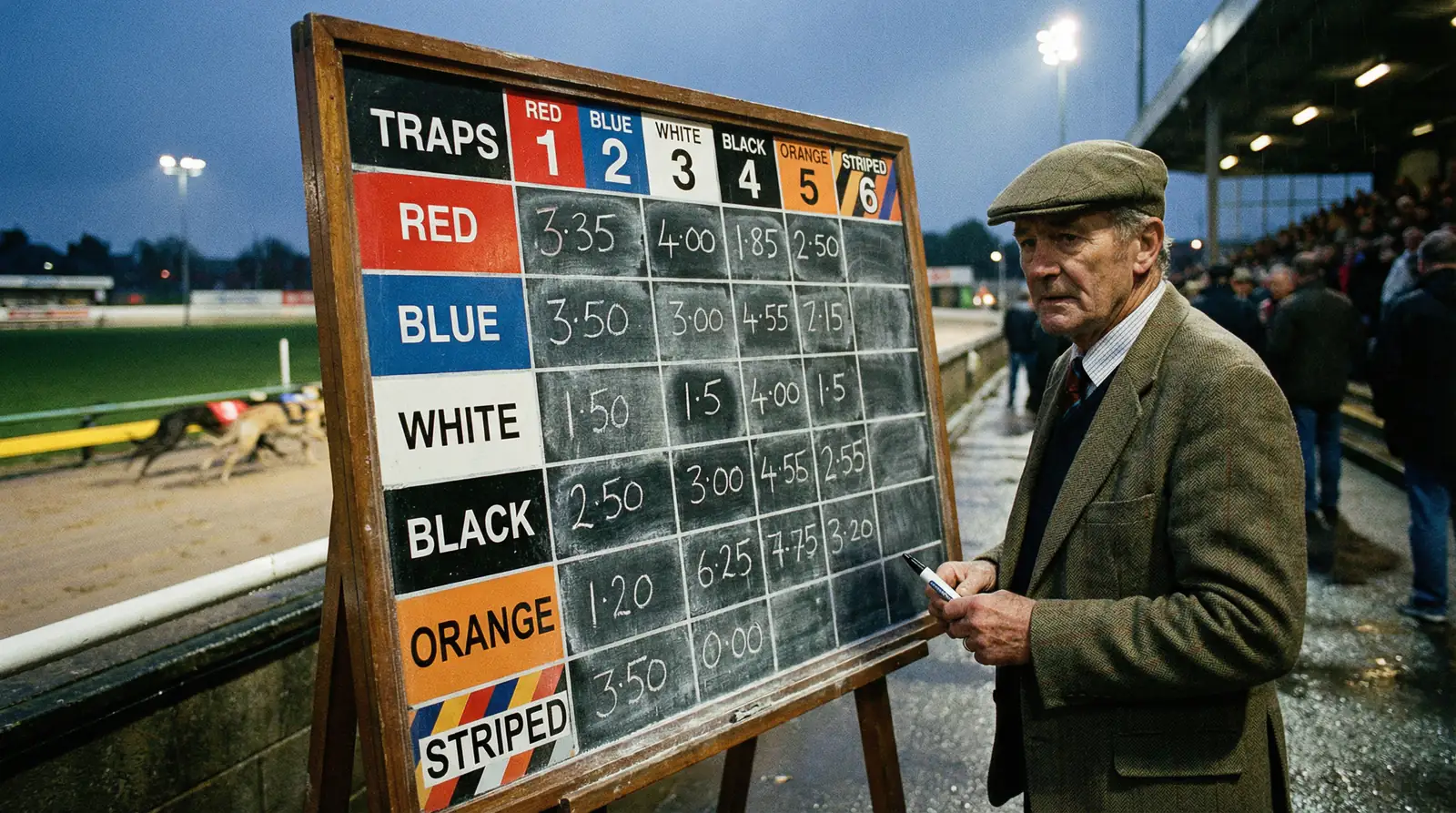
Greyhound odds are not performance ratings. They do not measure how fast a dog runs, how fit it is, or how talented its trainer believes it to be. Odds are prices — set by bookmakers to balance their risk, attract bets on both sides of the market, and guarantee a profit margin regardless of the result. Understanding this distinction is fundamental to reading Monmore odds properly, because it reframes the entire exercise from trying to predict the winner to trying to find mispriced runners.
A bookmaker sets the initial odds for a Monmore race by assessing each dog’s chance of winning based on form, trap draw, grade, and other public data. Those initial assessments are then converted into prices that include an overround — the bookmaker’s built-in margin. In a perfectly fair six-runner race where every dog had an equal chance, each would be priced at 5/1. In reality, the bookmaker prices the field so the implied probabilities of all six runners add up to more than 100%, typically between 115% and 130%. That excess is the overround, and it represents the cost of betting.
Once the initial prices are published, the market takes over. Money flows in from punters across the country, and the bookmaker adjusts the odds to manage their exposure. If heavy money lands on a particular dog, its odds shorten — the bookmaker is offering a smaller return to discourage further bets on that runner. Simultaneously, the odds on less-backed dogs may drift longer, offering a bigger return to attract balancing money. This process is continuous from the moment odds are published until the race begins, and the final pre-race prices reflect the collective judgement of every punter who has placed a bet.
For Monmore punters, the practical implication is straightforward: odds are not a rating of the dog, they are a rating of the market’s opinion of the dog. A dog at 2/1 is not twice as good as a dog at 5/1 — it has attracted twice as much money. Those two things are correlated but not identical, and the gap between them is where betting value exists.
Early Prices Versus Starting Price
The timing of your bet matters as much as the selection itself. Early prices — the odds available hours before a Monmore race — and the Starting Price — the final odds at the moment the traps open — can differ significantly for the same dog in the same race. Understanding when to bet, and which price to target, is a strategic decision that affects your long-term returns.
Early prices are published by bookmakers in the morning or early afternoon for evening Monmore meetings, and sometimes the night before for afternoon fixtures. These prices are set by the bookmaker’s traders based on their assessment of the form, and they represent the market before any significant betting volume has shaped it. Early prices can offer value when the bookmaker’s initial assessment underestimates a dog’s chance — a scenario that occurs more often in greyhound racing than in football or horse racing, because the greyhound betting market attracts less analytical money and the prices are set with less granular data.
The Starting Price is the industry-standard price recorded at the moment the race begins. It reflects the market’s final position after all the betting has taken place. For favourites and well-fancied runners, the SP is often shorter than the early price, because money has been piling on throughout the day and the bookmaker has cut the odds in response. For less-fancied runners, the SP can be longer than the early price if the market’s money has gone elsewhere and the bookmaker has eased the odds to attract attention.
Best Odds Guaranteed eliminates the need to choose between early prices and SP for many bets. Under BOG, if you take an early price and the SP is higher, you receive the SP instead. If the SP is lower, you keep your original price. This arrangement means that taking the early price on a BOG-enabled bet is almost always the optimal strategy, because you lock in a floor price with the possibility of an upgrade. Not every bookmaker offers BOG on every Monmore race, so confirming the terms before you bet is worth the few seconds it takes.
The tactical approach for regular Monmore punters is to study the racecard and form before the early prices are published, identify your selections independently, and then take the early price if it represents value. If the early price is already shorter than your assessment suggests it should be, waiting for the SP or passing on the race entirely are both reasonable alternatives. The key is that your selection process is completed before you engage with the market, so the odds inform your staking decision rather than your selection decision.
Reading Odds Movement
Odds move for a reason, but that reason is not always informative. The instinct to interpret every price change as a signal — a shortening dog must be getting inside information, a drifting dog must have a problem — leads to overreaction and poor decision-making. Reading odds movement productively requires understanding what different types of movement actually indicate.
A steady shortening of odds from early morning to race time, across multiple bookmakers simultaneously, typically indicates genuine market confidence. Money from informed punters — people with access to trial times, kennel information, or sophisticated form analysis — tends to move the market in this direction. The shortening is gradual because the money enters the market over hours rather than in a single burst. When you see a Monmore dog’s price contract from 5/1 in the morning to 3/1 by race time, with the movement visible across Bet365, Ladbrokes, and Coral alike, the market is telling you something substantive.
A sudden, sharp shortening in the final minutes before a race is harder to interpret. It might represent late information — a positive trial, a trainer’s confidence communicated to connections — or it might represent a large single bet from a punter who has no special information but is willing to stake heavily on their opinion. In greyhound racing, where betting volumes are smaller than in horse racing, a single large bet can move the market noticeably without necessarily reflecting superior knowledge.
A dog drifting in the market — its odds lengthening from the morning price — does not automatically mean the dog is a poor prospect. It might mean that money has gone to other runners in the race, or that the bookmaker has adjusted the entire market structure to manage their overall position. A dog at 4/1 that drifts to 5/1 might be a better bet at 5/1 than it was at 4/1, because the form hasn’t changed but the price has improved. The drift is only a negative signal if you can identify a concrete reason for it — a trainer withdrawal, a poor trial, a going change that disadvantages the dog’s running style.
The most useful approach to odds movement is to treat it as supplementary information, not primary analysis. Your own form assessment, conducted before you look at the market, should determine your selections. The market movement then tells you whether the rest of the betting public agrees or disagrees with your assessment. If the market strongly disagrees — a dog you’ve rated as the likely winner is drifting heavily — that’s a prompt to recheck your analysis, not to abandon it. And if the market strongly agrees — your selection is being hammered in from 4/1 to 2/1 — that’s confirmation of your analysis but also a warning that the value may have evaporated.
The Overround and What It Means for Punters
Every Monmore race is priced so the bookmaker wins in aggregate. The overround — the margin built into the odds — is the mechanism that ensures this, and understanding how large it is and how it affects your betting is essential context for anyone placing bets regularly.
The overround is calculated by converting every dog’s odds to an implied probability and summing the results. If a race has six runners priced at 2/1, 3/1, 5/1, 6/1, 8/1, and 10/1, the implied probabilities are 33.3%, 25.0%, 16.7%, 14.3%, 11.1%, and 9.1%, totalling 109.5%. The fair total would be 100%, so the overround is 9.5%. This means the bookmaker is, in effect, charging you 9.5% for the privilege of betting on the race.
In UK greyhound racing, the overround on a typical Monmore race ranges from about 115% to 130%, depending on the bookmaker, the meeting type, and how competitive the race is. Afternoon BAGS races tend to carry a higher overround than Saturday evening open meetings, because the betting volume is lower and the bookmaker needs a wider margin to protect against variance. The overround is usually lowest at the largest bookmakers — Bet365, Ladbrokes, Betfair — and highest at smaller operators who cannot afford to trade on thin margins.
For punters, the overround means that finding value requires more than just picking winners. You need to pick winners at odds that are longer than their true probability of winning, and the overround makes this harder because it compresses every price below its fair level. A dog with a genuine 25% chance of winning should be 3/1, but the overround might push its price to 5/2 — shorter than fair value. To overcome the overround consistently, you need to find dogs whose true chance is underestimated by the market by a margin larger than the bookmaker’s built-in edge.
Comparing odds across multiple bookmakers is the simplest way to reduce the effective overround on your bets. If one bookmaker offers 3/1 and another offers 7/2 on the same dog, taking the 7/2 reduces the overround you’re paying on that specific bet. Over hundreds of bets across a Monmore season, consistently taking the best available price across two or three bookmakers narrows the gap between the market’s prices and the fair odds, giving you more room to profit from accurate selections.
Understand Monmore greyhound odds on the monmoredogsresults homepage.
Learn about odds formats for beginners in racing odds.
